
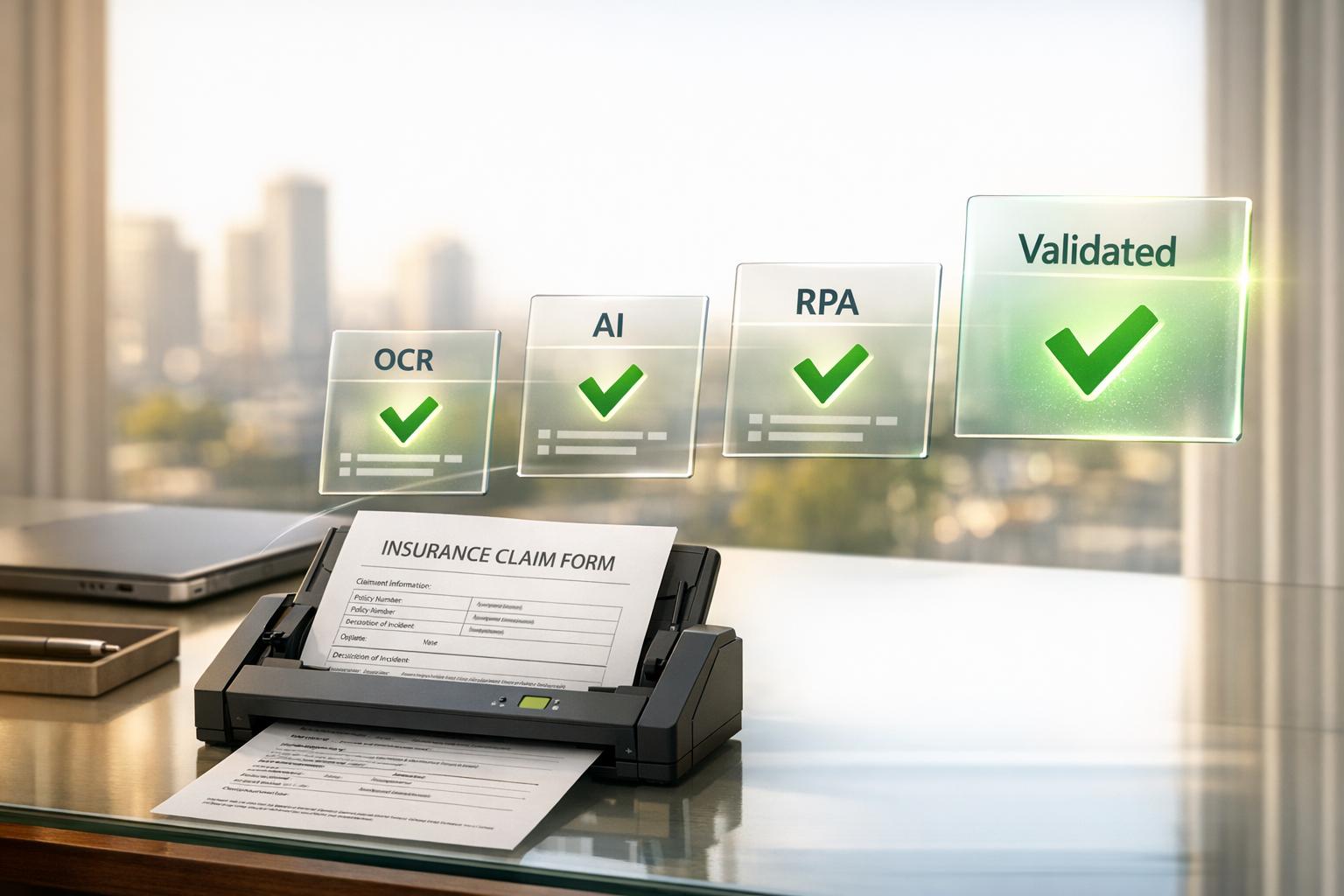
Automated claims validation is reshaping the insurance industry by making claims processing faster, more accurate, and less costly. Leveraging technologies like AI, machine learning, and OCR, these systems handle repetitive tasks, detect fraud, and improve customer satisfaction. Here’s why automation matters:
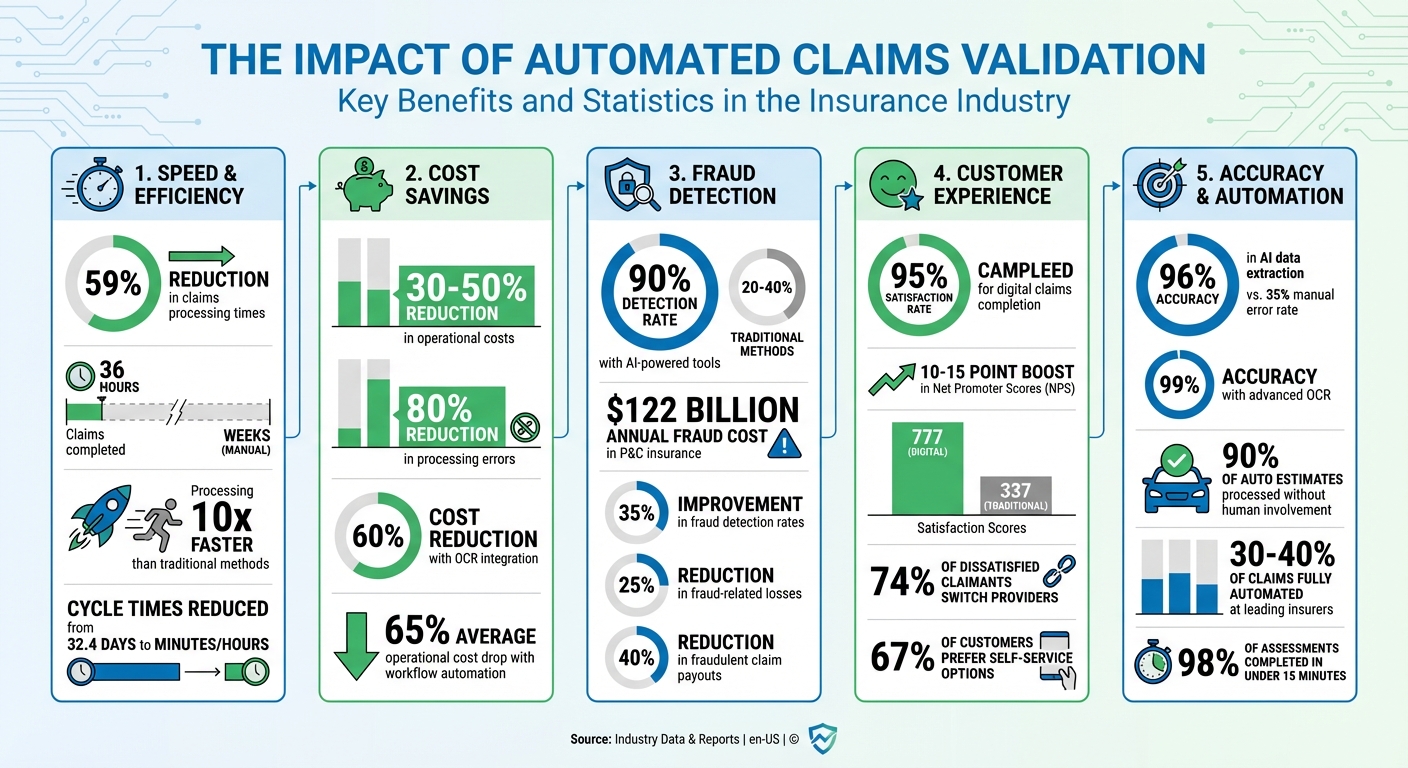
- Speed: Automation reduces claims processing times by up to 59%, with some claims completed in just 36 hours compared to weeks manually.
- Cost Savings: Companies can cut operational costs by 30%-50% and reduce errors by 80%.
- Fraud Detection: AI-powered tools identify up to 90% of fraudulent claims, saving billions annually.
- Customer Experience: Faster settlements and real-time updates lead to higher satisfaction and loyalty.
Automation is particularly impactful in credit insurance, where timely claims processing is critical to maintaining cash flow. By integrating AI, OCR, and RPA with existing systems, insurers can simplify workflows, reduce manual errors, and scale operations efficiently. Whether you’re looking to cut costs or improve accuracy, automated claims validation offers a clear path to modernizing insurance processes.
Automated Claims Validation: Key Benefits and Impact Statistics
How successful Insurers are using AI to solve targeted claims challenges
sbb-itb-b840488
Technologies Behind Automated Claims Validation
Automated claims validation leverages tools like AI, OCR, and integration systems to simplify claims processing. These technologies are designed to improve accuracy and efficiency, with AI systems achieving up to 96% accuracy in data extraction, a significant improvement over the 35% error rate often associated with manual methods. Here’s a closer look at how these technologies work together.
Artificial Intelligence and Machine Learning
AI and machine learning play a central role in making claims validation faster and smarter. By analyzing historical data, these systems can predict costs, flag potential fraud, and identify claims that need human review. For instance, models like BERT transform unstructured text – such as loss descriptions, emails, or adjuster notes – into structured, actionable data. These algorithms get smarter over time, learning from new claims and adapting to emerging fraud trends without requiring manual updates.
Real-world examples highlight the impact of AI. Admiral Seguros, in partnership with Tractable, implemented computer vision AI in late 2025 to assess vehicle damage. This system processed 90% of auto estimates without human involvement, completing 98% of assessments in under 15 minutes. Similarly, Lemonade reported that by late 2025, 30% to 40% of its claims were fully automated, with some renters’ theft claims approved and settled in just three seconds. Predictive analytics powered by AI has also improved fraud detection rates by 35%, while automation reduces manual workloads by 30% to 50% for straightforward claims. While AI handles decision-making, OCR ensures the accuracy of data input from various documents.
Optical Character Recognition (OCR) for Data Extraction
OCR is another essential piece of the puzzle, converting physical and digital documents into machine-readable text. This eliminates the need for manual data entry, saving time and reducing errors. OCR systems preprocess documents by removing noise, correcting skewed images, and adjusting contrast to enhance accuracy. Advanced OCR solutions, often integrated with intelligent document processing, use AI to understand document layouts and context, achieving up to 99% accuracy – far better than the 85%-95% range seen with older OCR systems.
These systems can automatically identify and extract key details like policy numbers, claimant information, dates, claim amounts, and vehicle identification numbers from diverse documents.
"Upstage OCR delivers over 95% accuracy, revolutionizing document processing." – Gyeong-won Jeon, Data Analytics Team Leader
OCR platforms also classify documents, distinguishing between medical receipts, invoices, and discharge summaries. Once the data is extracted, it is cross-checked against business rules or databases before being sent to other systems. By incorporating OCR into claims automation, insurers can cut costs by up to 60% and reduce processing times from weeks to mere hours.
Integration with Existing Systems
AI and OCR are powerful tools, but their full potential is unlocked through seamless integration with insurers’ existing platforms. This connectivity ensures that extracted data flows smoothly into ERP, CRM, and core insurance systems. APIs and middleware enable real-time data sharing, while OCR converts data into structured formats like XML, JSON, CSV, or healthcare-specific EDI 837, making it compatible with accounting or policy management systems.
Robotic Process Automation (RPA) takes over repetitive tasks, such as data entry and database cross-referencing, using the structured data provided by OCR. This interconnected system ensures that claims move efficiently from document intake to final settlement, streamlining the entire process.
How to Implement an Automated Claims Validation System
To successfully automate claims validation, you need a structured approach. The process starts with analyzing current workflows and gradually scales up, leveraging AI, OCR, and system integration for maximum efficiency.
Assessing Business Needs and Goals
Start by defining your objectives – whether it’s cutting costs, minimizing errors, or improving the customer experience. Carefully document your existing workflows to identify bottlenecks, redundancies, and common errors. Tasks like data entry, coverage verification, or billing schedule checks are prime candidates for automation since they are repetitive and non-strategic.
Next, audit your claims data for quality and completeness. Poor data quality can hinder AI performance. Establish baseline metrics, such as the average time-to-first-contact, error rates, and cost per claim, to measure improvements over time. Research shows automation can reduce claims processing costs by up to 30% and speed up settlements by 50%. Proper implementation directly contributes to these results by delivering faster settlements and reducing errors.
Choosing the Right Validation Rules and Tools
Validation rules form the backbone of your system. Early in the process, define the logic that governs tasks – such as coverage limits, date and phone number format checks, consistency checks (e.g., ensuring policy start dates come before end dates), and cross-referencing information across documents. Decide which tasks can be automated and which require human expertise, like complex liability decisions that still need skilled adjusters.
When selecting tools, focus on their ability to integrate with your existing systems, handle peak workloads, and offer customization through low-code or no-code solutions. Security and compliance are critical – make sure the tools align with standards like SOC 2, GDPR, and HIPAA. Vendors often use transaction-based pricing or seat-based licenses, with high-volume claims typically achieving a return on investment within 12–18 months.
"Smart automation is never ‘set it and forget it.’ Use analytics to track performance and adapt rules as regulations evolve." – EIS Group
Once your rules and tools are set, the next step is to test and fine-tune the system.
Testing, Training, and Continuous Monitoring
Begin with a pilot program, focusing on a simple claim type (e.g., auto glass) for three to six months. This allows you to account for seasonal variations and address integration issues before scaling up. During the pilot, compare automated results with manual processing to establish an accuracy baseline and ensure contingency plans are in place.
Training is vital. Offer hands-on workshops, role-specific training, and detailed documentation to your team. Include claims staff in the design phase to address practical challenges and ensure the system meets their needs. Once the system is live, use real-time dashboards to monitor error rates, processing times, and overall system health. Continuously refine validation rules based on performance data and evolving regulations. Most organizations see a 30%–50% drop in processing costs within the first year and an 80% reduction in errors.
Benefits of Automated Claims Validation
Automated systems bring about noticeable changes quickly. Businesses often see operational costs drop by as much as 30% within the first year, while claims processing times plummet – from an average of 32.4 days to just minutes or hours. These advancements redefine how claims operations function.
Cost Savings and Efficiency
Automation doesn’t just improve workflows – it saves money. Manual claims processing often hides inefficiencies. For example, nearly 20% of employee time is wasted searching for information to complete claims. Multiply that across thousands of claims, and these inefficiencies can result in losses reaching $160 billion over five years.
By automating repetitive tasks like data entry and document routing, these systems eliminate bottlenecks. The number of touchpoints in a claim’s lifecycle can be reduced from around 26 to as few as 9. This streamlined approach allows adjusters to dedicate their expertise to more complex cases, while automation handles the routine. It also equips businesses to manage sudden spikes in claims – such as those following natural disasters – without needing to scale up staffing proportionally.
Better Fraud Detection and Risk Mitigation
Beyond cost savings, automation significantly enhances fraud detection capabilities. Fraudulent claims cost the property and casualty insurance sector an estimated $122 billion annually, accounting for about 10% of losses in this area. Traditional detection methods, which rely on predefined rules, catch only 20–40% of fraud cases. In contrast, AI-powered systems boast detection rates approaching 90%. This leap in accuracy could save the industry between $80 billion and $160 billion by 2032.
Automated systems deploy multiple tools to identify fraud. For instance, computer vision algorithms analyze photo metadata and pixel details to flag manipulated images. Network analysis uncovers hidden connections between claimants, providers, and intermediaries, exposing organized fraud rings. Real-time cross-validation checks vehicle data, odometer readings, and GPS information against independent records. Additionally, natural language processing scans claim narratives to identify deceptive language patterns or duplicated stories.
"AI-powered systems can achieve fraud detection rates near 90%, a drastic improvement over traditional methods." – Jesse Goodwin, Co-Founder, theautomators.ai
Improved Customer Experience
Speed and transparency are game-changers when it comes to customer loyalty. A staggering 74% of dissatisfied claimants either switch providers or seriously consider doing so. This makes the claims experience a critical factor in customer retention. Automation tackles the very issues that frustrate customers – slow processing, poor communication, and inconsistent outcomes.
Digital intake through mobile apps allows policyholders to report losses and upload photos anytime, day or night. Real-time notifications – via SMS, email, or app alerts – keep customers informed at every step, easing their concerns and reducing the need for follow-up calls. For straightforward claims, automation enables approvals in minutes rather than weeks. Partnered with digital payment platforms like ClaimPay, payouts can be processed within 15 seconds of approval. Unsurprisingly, 95% of customers who complete the claims process digitally report being satisfied, and insurers often see a 10–15 point boost in Net Promoter Scores. Satisfaction scores also more than double – 777 versus 337 on a 1,000-point scale – when policyholders can communicate seamlessly with their insurer.
Automation also ensures fairness and consistency. Standardized validation rules eliminate human bias and reduce error rates – 19.3% in health insurance and 7% in commercial insurance. Fewer errors mean fewer wrongful denials and less rework, making the process smoother overall. With 67% of customers preferring self-service options, automation delivers through user-friendly interfaces and AI-powered chatbots that handle personalized inquiries instantly. These advancements highlight how automated claims validation reshapes modern insurance operations for the better.
Future Trends in Claims Validation Automation
The world of claims validation is moving from a reactive approach to one that’s more intelligent and purpose-driven. New developments are setting the stage for faster processing times and proactive risk management strategies. As these technologies evolve, they’re reshaping how claims are handled.
Advancements in Predictive Analytics and AI
Predictive analytics is reshaping claims management by identifying potential risks before they escalate. Instead of waiting for issues to arise, these systems analyze IoT data to forecast claim costs and flag litigation risks early. This shift has led to a 25% reduction in fraud-related losses and cut payouts on fraudulent claims by up to 40%. Machine learning models are also speeding up fraud detection, completing the process 50% faster than traditional methods, while reducing processing errors by up to 80%.
AI is also uncovering opportunities in subrogation, identifying an estimated $20 billion annually in recoveries that would have previously gone unnoticed. On top of that, sentiment analysis tools now monitor customer interactions, detecting signs of distress and escalating cases when needed. These advancements are paving the way for real-time, integrated claims workflows that are both efficient and responsive.
Automation’s Role in End-to-End Claims Management
Automation is driving a more seamless claims management process across the entire lifecycle. Straight-through processing (STP) allows routine claims to be settled instantly, reducing cycle times from weeks to mere minutes. Omnichannel intake systems use smart logic to ask follow-up questions based on initial data, ensuring claims are accurate from the start. Robotic Process Automation (RPA) is another game-changer, handling ten times the volume of manual tasks while cutting processing times by up to 60%.
Insurers using workflow automation have seen operational costs drop by an average of 65%. This level of integration connects adjusters, clients, and vendors in a unified system, enabling instant payouts and eliminating the delays caused by fragmented handoffs.
Agentic AI in Streamlining Processes
Agentic AI takes automation to the next level with its ability to make autonomous, goal-oriented decisions. Unlike traditional systems that rely on rigid rules, these AI tools can classify claims, cross-reference policy details, and calculate settlements using historical data – all without delays. They’re also equipped to handle unstructured data like emails, photos, and videos, making them far more versatile. For instance, if a diagnostic code is missing, agentic AI can proactively contact the clinic for the report instead of flagging it for manual follow-up.
"We are now entering the era of agentic AI: intelligent, goal-driven systems that work collaboratively to interpret data, make decisions, and adapt in changing conditions." – Agim Emruli, CEO, Flowable
The future of claims management will remain collaborative. AI will handle repetitive, time-sensitive tasks while human adjusters focus on complex or high-risk cases. Importantly, AI systems will provide detailed, auditable summaries of their actions, ensuring transparency and regulatory compliance. This is especially crucial for meeting standards set by organizations like the NAIC.
With 81% of insurance CEOs prioritizing AI investments, many companies are starting with high-volume, low-complexity workflows to test these systems before scaling up. The goal is not to replace human expertise but to free up professionals to focus on tasks that require judgment, empathy, and building relationships.
Conclusion
Why Businesses Should Adopt Automation
Automated claims validation has become a necessity for staying competitive. With 73% of executives still relying on outdated methods, AI-driven systems are changing the game by processing claims up to 10 times faster than traditional manual approaches. This leap in efficiency not only reduces costs and errors but also strengthens fraud detection and enhances the overall customer experience.
The financial advantages are hard to ignore. Companies that adopt automated claims validation often see operational costs drop by 30% to 50%, while processing errors are slashed by 80%. Beyond the numbers, automation plays a critical role in retaining customers. A poor claims experience can prompt 30% of policyholders to switch providers, making streamlined processes more important than ever.
"While 73% of insurance executives struggle with outdated claims processes, industry leaders are processing claims 10x faster using AI automation. The difference isn’t just technology – it’s competitive survival." – Raj Sanghri, Founder, Bitcot
These advantages highlight why a thoughtful, phased approach to implementation is key.
Next Steps for Implementation
Start by conducting a workflow audit to identify bottlenecks and establish clear objectives. From there, roll out a pilot program focusing on simple, high-volume claims. This allows for testing the system, measuring initial results, and creating a baseline ROI model before expanding to more complex claims. For many companies, this approach delivers payback within 12 to 18 months for high-volume claim types.
Select platforms that seamlessly integrate with your existing systems, and prioritize practical training for your team. Automation should complement human expertise, not replace it. By automating repetitive tasks, adjusters can focus on higher-value responsibilities that require judgment and personal interaction. With 79% of insurance agents already using or planning to use AI platforms, now is the time to embrace this shift.
FAQs
Which claim types should we automate first?
When it comes to tasks that are routine and repetitive, automation shines. Think about areas like data entry, claims form validation, and handling straightforward insurance claims, such as accident or policy claims. These processes typically rely on structured data, making them perfect candidates for automation.
By automating these tasks, companies can dramatically cut down processing times, reduce the likelihood of errors, and streamline overall operations. It’s a practical way to boost efficiency while maintaining accuracy.
How do we keep AI decisions accurate and auditable?
To make sure AI decisions are both reliable and easy to review, it’s essential to have strong tracking and monitoring systems in place. Consistently log and evaluate AI outputs to confirm they align with expected standards. Keep detailed audit trails to allow for retrospective reviews, which can help pinpoint and fix any errors or biases. Additionally, routinely test models against established benchmarks and use explainability methods to improve clarity. This approach supports trustworthy and compliant AI-driven claims validation.
What data quality is required for reliable automation?
For automation to truly work in claims validation, accurate, consistent, and error-free data is non-negotiable. When the data is reliable, it allows for precise analysis, smooth validation, and efficient processing. This reduces mistakes and keeps operations running more effectively.
To reach these levels of accuracy, organizations should implement systematic data validation processes. This can include using machine learning algorithms, enforcing business logic rules, and incorporating human review as a final safeguard. Together, these steps help ensure the data meets necessary standards.
The payoff? High-quality data doesn’t just cut down on errors – it also speeds up processing times and supports better decision-making in automated claims systems.
