
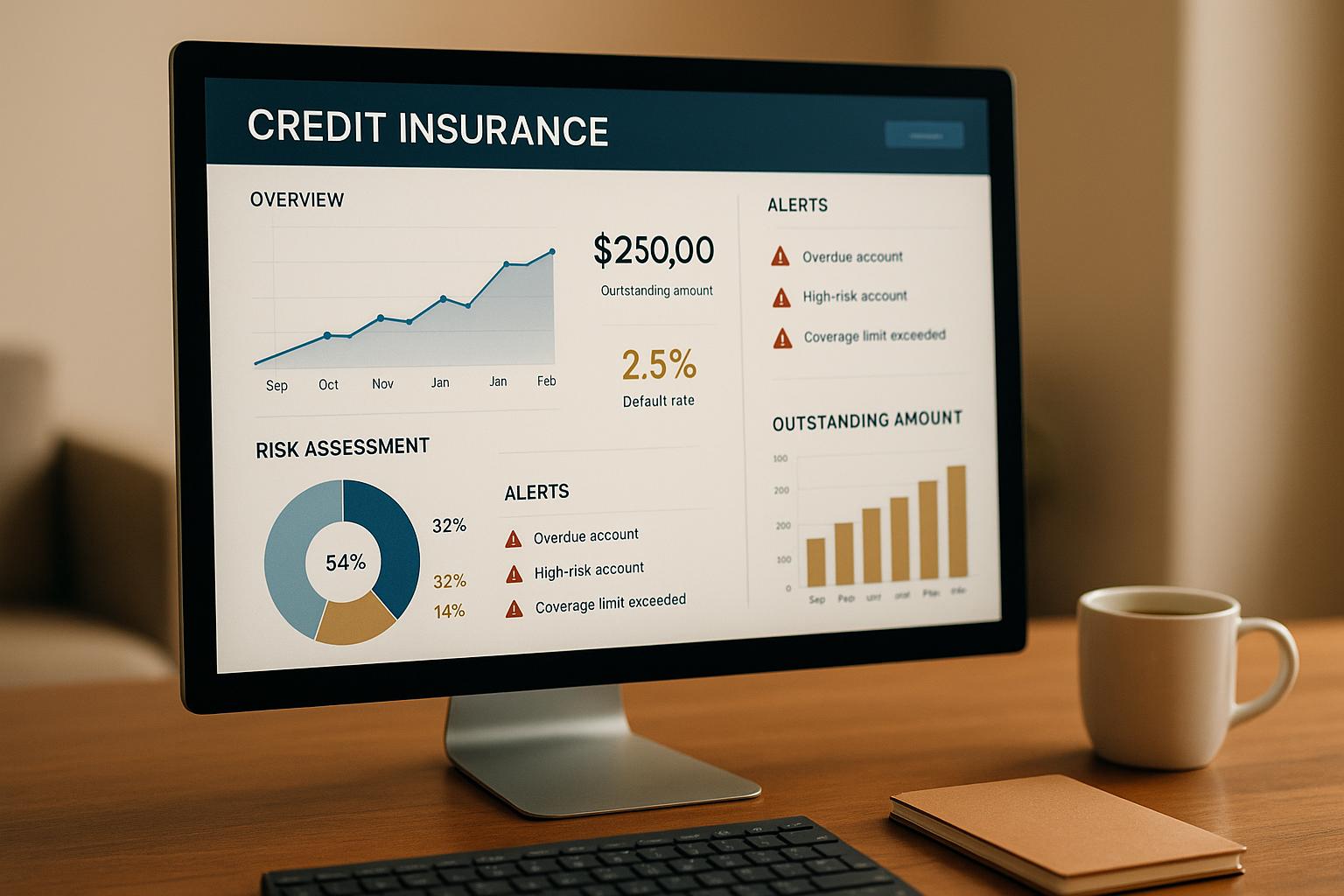
When businesses extend credit, unpaid invoices can disrupt cash flow and operations. Credit insurance mitigates this risk by covering up to 90% of losses from non-payment. However, traditional manual monitoring methods often fail to detect early warning signs of financial distress or fraud. This is where real-time monitoring tools come in.
These tools analyze transactions continuously, using machine learning and rules-based analytics to identify unusual patterns, such as delayed payments, account takeovers, or fraud schemes. By automating risk detection, they reduce errors, improve efficiency, and help insurers manage claims more effectively. Businesses benefit from early alerts, faster investigations, and better financial stability.
Key Benefits:
- Fraud Detection: Identifies suspicious transactions, such as sudden account activity or payments from high-risk regions.
- Non-Payment Risk Reduction: Tracks payment delays or partial payments to flag potential issues early.
- Efficiency: Automates monitoring, reducing manual workload and false positives.
- Scalability: Handles growing transaction volumes without additional staff.
Real-time monitoring tools not only strengthen credit insurance processes but also support businesses in managing risks proactively while maintaining compliance.
To Catch a Thief: Explainable AI in Insurance Fraud Detection | Ville Satopaa & Antoine Desir
The Problems of Non-Payment and Fraud in Credit Insurance
Non-payment and fraud are serious challenges for businesses and credit insurers, disrupting cash flow and day-to-day operations. These issues are constantly evolving, making traditional monitoring methods less effective over time. Real-time monitoring tools have become a critical line of defense, especially when you consider the specific threats these tools are designed to address. Let’s take a closer look at how non-payment and various fraud schemes interfere with credit insurance.
How Non-Payment Risks Impact Businesses
Non-payment creates immediate cash flow problems, depriving businesses of the working capital they rely on to operate. For small and medium enterprises (SMEs), even one major unpaid invoice can spiral into a liquidity crisis. Companies often extend credit to maintain valuable customer relationships, but this can backfire when they still need to meet their own payment obligations to suppliers. The ripple effect of delayed payments can damage their creditworthiness and make it harder to secure favorable financing terms.
Common Fraud Schemes in Credit Insurance
Fraud in credit insurance comes in many forms, each with its own set of challenges. One of the most damaging tactics is identity theft and account takeover, where criminals gain unauthorized access to customer accounts. These breaches often show up as unusual logins, high-value purchases from unexpected locations, or rapid transactions that deviate from normal behavior. Account takeovers are especially harmful because they exploit the trust already established between a business and its customers, making fraudulent activity harder to spot.
Another prevalent scheme is false claims, where customers allege non-payment after receiving goods or services. This forces insurers into time-consuming investigations. Then there’s merchant fraud, which involves suspicious patterns like unusually high refund rates or multiple payments from seemingly unrelated cardholders funneling to a single merchant. Organized fraud rings add another layer of complexity, systematically exploiting credit terms across multiple businesses.
Other warning signs include geolocation anomalies, such as transactions originating from flagged regions or unusual locations that suggest card testing or bot activity. Dormant accounts that suddenly execute large transfers are another red flag, often indicating a compromise. These fraud schemes not only threaten businesses but also expose insurers to risks like money laundering. For example, HSBC faced a £63,946,800 fine from the Financial Conduct Authority (FCA) for failing to implement adequate transaction monitoring systems.
Why Manual Monitoring Falls Short
The sheer scale of modern fraud and non-payment risks highlights the flaws in manual monitoring systems. High transaction volumes can easily overwhelm manual processes, creating blind spots where fraudulent activity goes unnoticed. These systems often depend on identifying previously known fraud patterns, which means they struggle to catch new or evolving schemes. By the time fraud is detected – often days or even weeks later – the damage may already be done.
Manual monitoring also demands significant resources and frequently produces false positives. Analysts waste valuable time investigating alerts that turn out to be legitimate, leading to fatigue and reduced effectiveness in catching real threats.
These shortcomings make it clear why businesses and credit insurers are increasingly adopting automated, real-time monitoring tools. These systems help detect and prevent non-payment and fraud more effectively, offering a much-needed safeguard in today’s high-risk environment.
How Real-Time Monitoring Tools Address Credit Insurance Problems
Real-time monitoring tools are changing the way credit insurance operates, moving it from a reactive claims process to a proactive approach to managing risk. By continuously analyzing transaction data, these tools can spot issues early, identifying both familiar fraud schemes and new, emerging threats.
How Real-Time Monitoring Works
Real-time monitoring thrives on detailed transaction analysis. It evaluates multiple data points like transaction amounts, counterparties, geolocations, and device details, all while comparing this information to expected customer behavior. These systems scrutinize various transaction types – such as wire transfers, ACH, and SWIFT payments – against watchlists to flag any suspicious parties. For credit insurance, they focus on the flow of funds between policyholders and their customers, analyzing payment timing, frequency, and amounts against established benchmarks to build a clear financial profile for each customer. Results are delivered almost instantly or according to a set schedule.
Each transaction is assigned a risk score based on customer profiles, transaction history, and timing. This scoring allows insurers to prioritize their investigations, focusing immediately on high-risk transactions while letting routine ones proceed without delay.
How Fraud Detection Works
Fraud detection combines predefined rules with machine learning to identify both known anomalies and new, emerging patterns. For instance, it can detect irregularities such as unexpected changes in payment locations or mismatches between a customer’s usual geolocation and the origin of a transaction – both of which might signal fraud or account takeovers.
Behavioral analytics play a significant role by establishing a baseline of normal activity. This makes it easier to spot deviations that could indicate trouble. For example, sudden shifts in transaction patterns might reflect legitimate growth, but they could also signal financial distress or fraudulent activity. A case in point: After HSBC faced a $63,946,800 fine from the Financial Conduct Authority (FCA), the bank implemented a machine learning-driven transaction monitoring system to strengthen its fraud detection capabilities.
Together, these tools not only help detect fraud but also create a foundation for addressing non-payment risks.
Preventing Non-Payment Losses
Real-time monitoring is also invaluable in reducing the risk of non-payment. By tracking warning signs like slower payment speeds, partial payments instead of full ones, or payments from unusual sources, these systems can detect financial distress early. This allows credit insurers to flag high-risk transactions, investigate further, and take action before losses occur.
These systems often integrate with case management tools and use AI to prioritize alerts, cutting down on false positives and speeding up investigations. This enables insurers to act quickly – sometimes within minutes – by blocking or investigating suspicious transactions, ultimately minimizing non-payment risks and protecting financial stability.
sbb-itb-b840488
Business and Financial Benefits of Monitoring Tools
Beyond just identifying fraud and preventing non-payment, monitoring tools provide credit insurers with a powerful way to strengthen their financial standing. By offering real-time insights, these tools enhance risk management, improve operational efficiency, and support business growth.
Better Risk Management
Monitoring tools allow credit insurers to shift from reacting to claims toward actively preventing risks. By continuously analyzing transaction patterns and customer behavior, these tools can spot irregularities like dormant accounts suddenly making large transfers or cross-border payments from questionable sources.
Using a risk scoring system, transactions are automatically prioritized for review. High-risk activities, such as large withdrawals or transfers to high-risk regions, trigger alerts for immediate investigation. Meanwhile, routine transactions proceed without interruption. This system ensures that analysts can quickly reassess a customer’s creditworthiness when unusual behavior is detected.
These insights also refine underwriting and pricing strategies. For example, historical data can reveal which behaviors – like consistent cash flow and avoiding high-risk jurisdictions – align with lower risks. Customers demonstrating these patterns may receive more favorable pricing, while those with erratic activity could face higher premiums or closer scrutiny.
Greater Efficiency
Automation has transformed how compliance teams operate, taking over tasks that once required extensive manual effort. Instead of reviewing every transaction against a checklist, software now scans for potential threats and flags them for further analysis. This approach not only simplifies reporting and alert management but also allows teams to concentrate on investigating flagged cases and making critical decisions.
Unlike human analysts, automated systems work around the clock without fatigue, monitoring deposits, withdrawals, and transfers constantly. For credit insurers, this means claims teams can handle more cases without needing additional staff, leading to reduced operational costs while maintaining compliance.
Advanced analytics also help cut down on false positives, saving time and money. By distinguishing legitimate transactions from genuinely suspicious ones, insurers can speed up the processing of valid claims. For instance, reducing false positives by just 10% across thousands of monthly transactions can lead to significant cost savings and improved customer satisfaction.
Additionally, monitoring tools simplify compliance with regulations like Anti-Money Laundering (AML), Customer Due Diligence (CDD), and Know Your Customer (KYC) requirements. By maintaining detailed audit trails of all transactions and investigations, credit insurers can demonstrate robust compliance practices to regulators, reducing legal risks and reinforcing their commitment to combating financial crime.
Scalability for Business Growth
Monitoring systems are designed to scale easily as transaction volumes grow, enabling insurers to expand without significantly increasing compliance staff. Instead of hiring more analysts to manage rising workloads, these automated systems handle the additional transactions seamlessly.
This scalability is especially critical for credit insurers entering new markets or serving larger client bases, where transaction volumes and complexities often surge. For instance, a system managing 100,000 transactions per month can typically be adjusted to handle 1,000,000 with minimal extra investment.
Consider a mid-sized credit insurer experiencing 30% annual growth. By relying on automated monitoring, they can maintain the same team size while boosting profit margins and return on investment. This efficiency becomes a competitive edge as insurers pursue larger clients and expand into regions with more complex financial landscapes. These systems also integrate smoothly with existing infrastructure, making implementation straightforward and cost-effective.
How to Implement Monitoring Tools for Credit Insurance
Introducing monitoring tools into your credit insurance processes doesn’t mean you have to completely revamp your existing systems. The goal is to integrate these tools in a way that enhances operations while keeping your daily workflows running smoothly.
Connecting with Current Systems
Modern monitoring tools are designed to connect seamlessly with your current infrastructure. By using APIs and middleware, they can pull data from your policy management systems, claims databases, and customer records without disrupting your operations. This means your underwriting team, claims adjusters, and finance department can continue their work uninterrupted while the tools analyze transactional data in the background.
The integration process allows these tools to automatically gather transaction data from your banking systems, payment processors, and internal records. For credit insurers, this means monitoring software can track fund movements tied to policies, flagging unusual activity without requiring manual input or major system changes. Compliance teams can then review flagged transactions for any suspicious patterns without added complexity.
These systems analyze key data points like transaction amounts, counterparties, geolocations, and device details, comparing each to expected customer behavior to detect anomalies. Given the high volume and large transaction values in credit insurance, this capability is critical for identifying potential money laundering or fraud risks. With proper integration, these tools can tackle these risks without interfering with legitimate business activities, setting the stage for more tailored risk detection.
Setting Up Custom Monitoring Rules
Once data flows are integrated, you can refine your system further by creating custom monitoring rules that align with your portfolio’s specific needs. These rules help filter out routine activity while focusing on genuine risks.
Start by defining baseline transaction patterns for your typical customers and policy types. This includes factors like standard payment amounts, frequency, and counterparties. For instance, a $50,000 wire transfer might be flagged for a small business policy but considered normal for a large corporate account. Modern systems allow for this level of customization without requiring deep technical expertise.
Next, establish rules to identify credit insurance-related fraud. Examples include sudden changes in payment behavior, unusually large claims shortly after a policy starts, or payments from high-risk regions. You can also set thresholds for claim frequency or track patterns where multiple unrelated policyholders send payments to the same entity.
To enhance rule-based detection, incorporate machine learning capabilities. While rules focus on known risks, machine learning algorithms can uncover patterns and trends you might not yet anticipate. These algorithms continuously learn from past transactions, improving their ability to distinguish between legitimate and suspicious activity over time.
Your system should also allow for easy adjustments to alert thresholds based on factors like policy type, customer risk profile, or transaction size. This flexibility ensures that your monitoring stays aligned with both your business operations and the evolving landscape of fraud threats.
Maintaining Security Without Friction
Effective monitoring tools balance security with the need to keep legitimate transactions moving. The key is to implement a tiered alert and response system that prioritizes risks without overwhelming your team with false positives.
Instead of automatically blocking all flagged transactions, these systems use risk scoring to classify alerts by severity. High-risk alerts might require immediate investigation or claim denial, medium-risk alerts could trigger requests for additional documentation, and low-risk alerts might simply be monitored.
For legitimate transactions that raise alerts, the system can perform non-intrusive checks like asking for customer confirmation before processing, rather than outright blocking the transaction. For example, if a policyholder’s payment behavior suddenly shifts, the system might flag it for review but still allow the transaction to proceed while an analyst looks into it.
Real-time screening capabilities also play a critical role. These tools can cross-check all entities involved in a payment – whether through wire transfers, ACH payments, or other methods – against watchlists and infraction databases. This ensures compliance with regulations while minimizing disruptions for legitimate transactions. Over time, the system adapts to reduce false positives as it learns more about your customer base and their typical behaviors.
Monitoring systems must also adhere to Anti-Money Laundering (AML) regulations, as well as Know Your Customer (KYC) and Customer Due Diligence (CDD) standards. They should provide audit-ready reporting to document all monitoring activities, alerts, and investigations for regulatory reviews.
To ensure data security, these systems should include encryption for data in transit and at rest, role-based access controls to restrict sensitive information, and detailed audit logs for tracking system access and changes. This level of security safeguards policyholder information, claims data, and payment details while ensuring compliance with data protection laws.
Failing to maintain effective monitoring systems can result in hefty fines, legal consequences, and reputational damage. By prioritizing security measures from the outset, you not only protect your organization but also ensure efficient and proactive risk management – an essential aspect of credit insurance.
Conclusion
Real-time transaction monitoring tools have reshaped how credit insurers approach risk management. By continuously analyzing transaction patterns and flagging suspicious activities early, these systems tackle long-standing issues in the credit insurance industry, such as non-payment risks and fraud. They not only identify threats quickly but also streamline processes, making operations more efficient.
The combination of rules-based analytics and machine learning allows insurers to uncover both well-known and emerging fraud schemes. This includes detecting staged claims, inflated invoices, and entirely new fraud tactics. The result? Faster identification of risks, better scoring of potential threats, and the ability to act before fraudulent claims are processed or funds are misappropriated.
Automation plays a key role by reducing the manual workload for compliance teams. Instead of spending time on countless routine reviews, teams can focus their expertise on investigating high-risk cases. Meanwhile, the system handles thousands of transactions and ensures audit-ready documentation is maintained for regulatory purposes.
These automated systems also scale seamlessly with growing transaction volumes, allowing insurers to expand their business without needing to proportionally increase staff. This scalability offers the confidence to explore new markets or take on higher-risk segments, knowing the monitoring infrastructure can adapt and keep up with demand.
As highlighted, real-time monitoring strengthens both risk management and fraud prevention. For credit insurers, adopting these advanced tools not only minimizes losses but also supports growth, providing a competitive edge in an increasingly challenging financial environment. With global economic pressures leading to rising insolvency rates, the ability to monitor and evaluate non-payment risks continuously has become a critical safeguard against devastating losses.
While integrating these tools may require initial effort – such as connecting them to existing systems and setting up custom monitoring rules – the long-term advantages are undeniable. Reduced fraud, greater efficiency, regulatory compliance, and the ability to scale operations make these monitoring systems a cornerstone of modern credit insurance strategies.
FAQs
How do real-time monitoring tools help identify fraud and reduce non-payment risks in credit insurance?
Real-time monitoring tools are an essential asset in credit insurance, offering businesses immediate insights into transactions and customer behavior. These tools help identify unusual patterns, like abrupt shifts in payment habits or inconsistencies in account activity, which can signal potential fraud or risks of non-payment.
By constantly analyzing data, these systems allow businesses to respond swiftly – whether it’s flagging a risky transaction, modifying credit terms, or taking preventative action. This kind of quick decision-making helps reduce financial losses while reinforcing trust and reliability in managing credit risks and accounts receivable.
How can real-time monitoring tools be integrated with credit insurance systems to improve risk management?
Integrating real-time monitoring tools with credit insurance systems can strengthen risk management and improve overall functionality. To start, evaluate your current credit insurance platform to see if it’s compatible with the monitoring tool you plan to use. Once compatibility is confirmed, configure the tool to monitor specific transactions, paying close attention to areas like non-payment risks or unusual activities that might signal potential fraud. Lastly, set up the system to deliver automated alerts and actionable insights, ensuring you can address potential problems swiftly and effectively.
By merging these tools with your credit insurance, you can minimize financial risks while gaining clearer visibility into your accounts receivable. This not only safeguards your business but also empowers you to make decisions with greater confidence, supporting sustainable growth.
How do monitoring tools help credit insurers meet regulations like AML, KYC, and CDD while minimizing disruptions?
Monitoring tools are essential for credit insurers to stay aligned with regulatory requirements such as Anti-Money Laundering (AML), Know Your Customer (KYC), and Customer Due Diligence (CDD). These tools enable real-time tracking of transactions and thorough data analysis, making it easier to spot risks like fraud or regulatory breaches before they escalate.
By automating compliance checks and identifying suspicious activities, these tools cut down on manual work and minimize interruptions to daily operations. This not only streamlines workflows but also ensures compliance with stringent regulations. On top of that, using such tools shows clients that insurers are committed to managing risks responsibly, helping to build stronger relationships and trust.
