
Blockchain in Supply Chains: Does It Deliver ROI?
By 2026, blockchain has transformed supply chains by improving traceability, reducing disputes, and cutting costs. Companies like Walmart and Pfizer have already saved millions by using blockchain to address challenges like slow recalls, counterfeit goods, and manual processes. However, with high upfront costs (ranging from $250,000 to $2 million), organizations must carefully evaluate whether blockchain’s benefits outweigh its investment.
Key Takeaways:
- ROI Potential: Blockchain delivers a 41% positive ROI on average. Payback often occurs within 12–18 months, with long-term savings of 20–30%.
- Efficiency Gains: Traceability times drop from days to seconds. Smart contracts reduce disputes by 30–40% and automate processes.
- Challenges: Initial setup costs are steep, and 53% of companies struggle with legacy system integration. A skilled workforce is essential.
- Use Cases: Food safety, pharmaceuticals, trade finance, and logistics benefit most from blockchain’s transparency and automation.
Steps to Evaluate Blockchain for Your Supply Chain:
- Identify Pain Points: Traceability delays, fraud, and manual workflows are common issues blockchain can address.
- Assess Readiness: Ensure your systems can handle blockchain’s demands and involve cross-functional teams early.
- Set ROI Goals: Define measurable targets like cost reductions or faster processing times.
- Choose Use Cases: Focus on high-impact areas like recalls, compliance, and fraud prevention.
- Pilot and Scale: Start small, measure results, and expand gradually.
Blockchain isn’t a one-size-fits-all solution, but with proper planning, it can drive measurable financial results and operational improvements in supply chains.
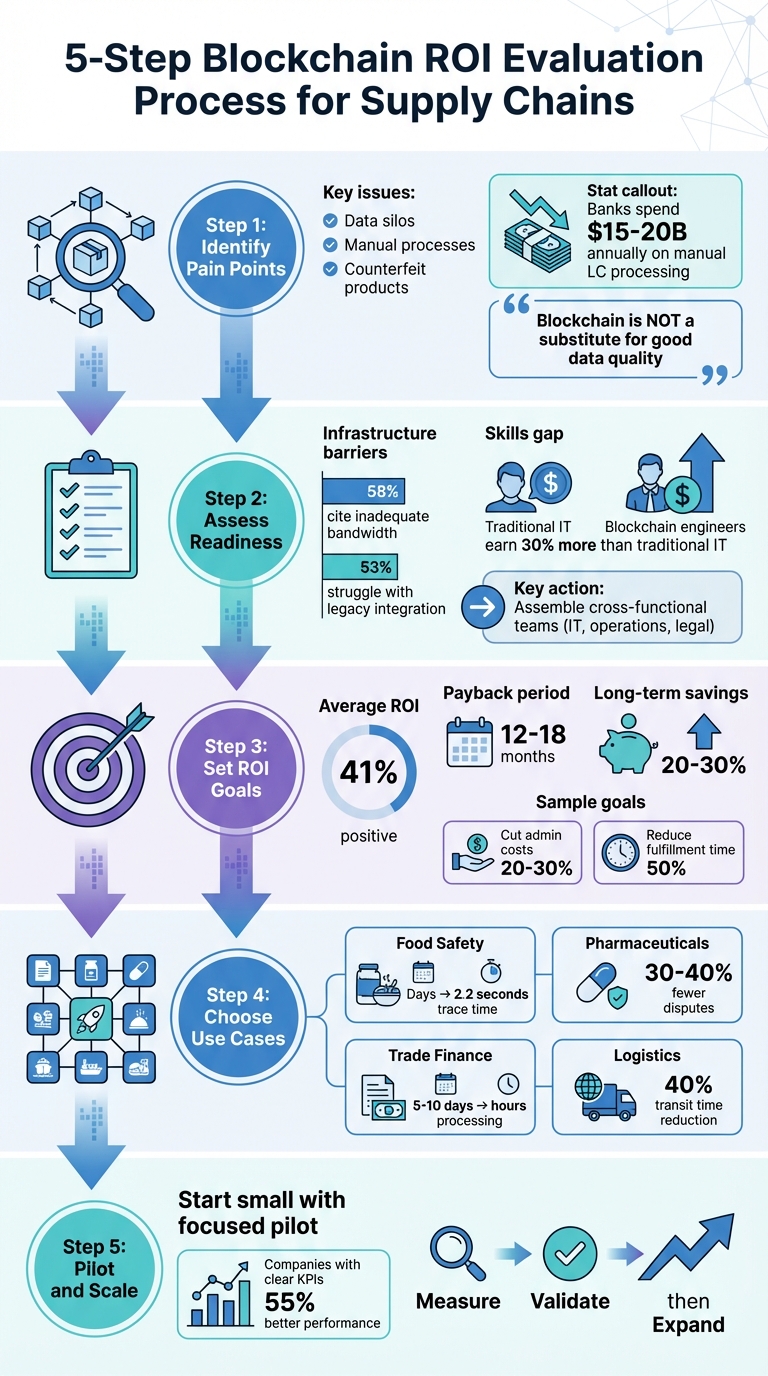
5-Step Blockchain ROI Evaluation Process for Supply Chains
Pre-Implementation Assessment
Identify Pain Points in Your Supply Chain
Start by pinpointing the specific supply chain challenges that blockchain could address. Not every issue requires blockchain – some may be better handled with traditional databases.
Typical pain points include data silos, where disconnected systems between partners limit real-time visibility. Manual processes and delayed traceability are also major hurdles, often slowing operations and inflating costs. For example, banks spend an estimated $15–20 billion annually on manually processing Letters of Credit, while tracing products during recalls can take days or even weeks with conventional systems. Industries like pharmaceuticals face another critical challenge: counterfeit products. The World Health Organization estimates that in certain markets, 10–30% of pharmaceutical products are counterfeit. Additionally, high reconciliation costs eat into resources as supply chain partners dedicate significant labor hours to resolving invoice disputes.
A crucial reminder from the ECOSIRE Research and Development Team encapsulates the importance of data quality:
"Blockchain is NOT a substitute for good supply chain data quality – garbage in, garbage out applies fully".
In other words, if your data is flawed, blockchain will only create a permanent record of those inaccuracies.
Once you’ve identified these issues, evaluate your organization’s readiness to adopt blockchain technology.
Organizational Readiness Checklist
Assessing your organization’s preparedness is a key step for successful blockchain integration. Start by examining your infrastructure. For instance, 58% of supply chains report that inadequate network bandwidth and storage capacity are barriers to implementation. Additionally, 53% of enterprises face challenges integrating blockchain with outdated legacy systems, while 63% struggle with data silos that block seamless integration.
Another significant hurdle is the skills gap. Blockchain engineers often command salaries that are 30% higher than those of traditional IT roles. On top of that, 38% of organizations encounter resistance from employees unfamiliar with decentralized systems. Early engagement with stakeholders is crucial – 73% of businesses highlight this as a vital factor for successful adoption.
To address these challenges, conduct a feasibility study to identify gaps in technology and workflows. Assemble cross-functional teams that include IT, operations, and legal experts to ensure that all aspects of your organization are covered.
Finally, establish clear baseline metrics to measure the impact of blockchain post-implementation.
Establish Baseline Metrics
To measure the return on investment (ROI) effectively, you need to set clear baseline metrics before implementing blockchain. Start by documenting your current financial, operational, and compliance data.
For financial metrics, record administrative costs, transaction expenses, and overhead related to manual paperwork and intermediaries. Track operational metrics like transaction speeds, peak activity periods, and failure rates. Evaluate inventory performance by noting holding times, turnover rates, storage costs, and the frequency of write-offs. Also, assess traceability by measuring how long it takes to retrieve product origin details or respond to recall situations.
Organizations that define clear KPIs before implementation see 55% better performance outcomes compared to those that don’t. Set specific goals, such as reducing administrative costs by 20–30%, cutting order fulfillment times by 50%, and achieving near-zero data error rates through automation. These benchmarks will guide your efforts and help you track progress effectively.
sbb-itb-b840488
Define ROI Objectives and Use Cases
Set Measurable ROI Goals
After establishing your baseline metrics, the next step is to turn those numbers into actionable ROI targets that directly tackle your supply chain’s biggest challenges.
For example, set financial goals like cutting down Letter of Credit (LC) processing costs or reducing dispute rates. Consider this: banks currently spend a staggering $15–20 billion annually on manual LC processing. Blockchain technology can slash processing times from 5–10 days to just a few hours, while smart contracts have already shown a 30–40% drop in disputes.
"Implementing technology without clear ROI targets is unsustainable."
– Ravi Chamria, CEO of Zeeve
To evaluate the benefits, use an MCDA scorecard to weigh both tangible outcomes (like cost savings and faster processes) and intangible ones (such as minimizing hacking risks and boosting brand reputation). Companies that have adopted blockchain solutions report a 41% positive ROI.
Once your goals are clear, the next focus should be identifying use cases that align with these objectives.
Identify High-Impact Use Cases
With your ROI goals in place, it’s time to zero in on use cases that deliver measurable results. These use cases should address critical supply chain challenges where the stakes are high, and the need for secure, multi-party traceability is undeniable.
Product Traceability
Take Walmart’s example: in 2018, they used IBM Food Trust (built on Hyperledger Fabric) to combat an E. coli outbreak in romaine lettuce. This blockchain solution reduced trace times from 6 days and 18 hours to just 2.2 seconds. As a result, Walmart could execute targeted recalls, saving millions by avoiding unnecessary removal of unaffected products.
Fraud Prevention and Compliance
By March 2026, the MediLedger network helped pharmaceutical giants like Pfizer and Genentech meet DSCSA compliance standards. Blockchain technology cut dispute resolution times from weeks to just hours, a critical improvement in an industry where counterfeit drugs make up 10–30% of products in certain markets.
Process Automation through Smart Contracts
IBM and Maersk’s TradeLens platform showed how blockchain could transform ocean freight. By using blockchain-based document sharing, they reduced transit times by up to 40%. Smart contracts further streamlined operations by automatically triggering payments or actions when predefined conditions were met, removing manual steps and reducing errors.
Sustainability Tracking
Blockchain is also making waves in ethical sourcing and emissions tracking. For instance, Deloitte developed a "Track and Trace" prototype using Hyperledger Fabric and IoT sensors to monitor international shipments. This system records location data on an immutable ledger, ensuring transparency and preventing tampering.
| Use Case | Primary Challenge Addressed | Key ROI Driver |
|---|---|---|
| Food Traceability | Pathogen outbreaks / slow recalls | Trace time reduced from days to seconds |
| Pharmaceuticals | Counterfeiting / DSCSA compliance | Automated verification / faster dispute resolution |
| Trade Finance | Manual LC processing | Processing time cut from days to hours |
| Conflict Minerals | Ethical sourcing / ESG compliance | Verifiable provenance / brand protection |
| Logistics | Paper-based documentation | Transit time reduced by up to 40% |
Review Case Studies and Benchmarks
Once you’ve identified potential use cases, dive into real-world benchmarks to refine your strategy. These examples highlight how targeted blockchain solutions can maximize ROI.
One major decision is whether to "build" your own blockchain network or "join" an existing one. Joining an established network typically costs between $50,000 and $500,000 for setup, plus annual fees ranging from $20,000 to $100,000. On the other hand, building a proprietary network can require an initial investment of $500,000 to $5,000,000 along with ongoing costs. For most organizations, joining an existing network ensures quicker ROI compared to starting from scratch.
"The key to understanding blockchain in supply chains in 2026 is precision: knowing which problems the technology genuinely solves, which it merely addresses expensively, and which are better addressed by conventional databases."
– ECOSIRE Research and Development Team
When setting expectations, consider the implementation phase. Early pilot projects often yield limited results, while the "Network of Networks" phase – where the system scales across multiple partners – offers the greatest potential for ROI. Aligning your goals with the project’s stage is crucial to avoid early-stage disappointment.
Platform Selection and Pilot Planning
Blockchain Platform Selection Criteria
When choosing a blockchain platform, it’s important to align it with your supply chain needs and technical goals. Start by evaluating the architecture type. Public blockchains provide open access and transparency, private blockchains offer centralized control with enhanced confidentiality, and consortium blockchains strike a balance, making them ideal for collaboration across organizations.
Transaction throughput is another key factor. For example, Bitcoin processes only 5-7 transactions per second (TPS), while Ethereum, with Layer 2 solutions, can handle about 90 TPS. Platforms like Hyperledger Fabric, which supports up to 3,000 TPS, are better suited for high-volume supply chain operations. Additionally, the consensus mechanism – whether it’s Proof of Stake, Proof of Authority, or Proof of History – affects the platform’s security, scalability, and energy efficiency.
Integration readiness is critical for ensuring compatibility with your existing systems. Platforms like Hyperledger Fabric, with modular designs, make it easier to connect to ERP and inventory management systems. Research shows that 53% of enterprises face challenges integrating blockchain with legacy systems. Look for platforms that offer secure middleware and encrypted APIs to bridge blockchain modules with your current infrastructure.
"79% of executives believe that the system improves transparency in the supply chain."
– Deloitte
Adoption rates within the industry also matter. A widely adopted platform typically offers better support, active development resources, and a thriving community. Assess the platform’s security record, programming language support (e.g., Solidity, Go, Python), and fee structures to ensure they meet your technical and budgetary needs. After selecting a platform, design a controlled pilot to measure its effectiveness.
Design a Pilot Program
A successful pilot program begins with a narrow focus. Instead of tackling your entire supply chain, choose a single product line or category. This approach increases the likelihood of success. Companies with clearly defined KPIs for blockchain projects perform 55% better than those without.
Set specific KPIs for your pilot, such as ensuring 90% real-time data availability, 95% audit trail accessibility, and 85% traceable transaction records. Address challenges like the oracle problem by integrating IoT sensors, RFID tags, QR codes, or NFC tags. For instance, the fintech platform Mesha implemented a blockchain module with smart contracts, achieving a 2.2x acceleration in supplier payments and cutting reconciliation time by 48% within just 60 days.
Another example comes from the Australian Trade and Investment Commission’s pilot with VeChain, which improved export tracking efficiency by 38% for cattle shipments to China by combining blockchain with physical tracking tools.
Using a phased implementation strategy minimizes risks. Starting small can reduce implementation risks by up to 70%. Test usability and performance with smaller frameworks like Ethereum or Corda before committing to larger-scale investments. Engaging stakeholders early in the process is also crucial – organizations that involve more stakeholders during the pilot phase see better alignment and stronger results. Once your pilot is designed, ensure seamless integration with existing infrastructure.
Integration Considerations
With your pilot program in place, focus on smooth integration with current systems. Secure middleware and encrypted APIs are essential for connecting blockchain modules to ERP systems without disrupting operations. Pilot projects for blockchain integration typically cost around $15,000, while full-scale implementations can exceed $120,000.
Before implementation, conduct a system audit to identify data silos and assess IT bandwidth. This step helps avoid infrastructure bottlenecks, which affect 58% of supply chains. Disjointed data management systems hinder information flow, a challenge faced by 63% of organizations. Addressing these gaps during the pilot phase can save significant time and money later.
Employee training is another critical factor. Resistance to decentralized systems stems from a lack of familiarity, which affects 38% of organizations. Dedicate at least 20% of training time to hands-on simulations, aiming for a minimum of 60 hours per employee. This investment improves knowledge retention by 30% and eases the transition.
Finally, carefully connect IoT devices to your blockchain infrastructure. While 79% of companies are exploring IoT integration to enhance visibility, 90% of IoT devices have security vulnerabilities. Implement robust security protocols from the outset to safeguard data integrity and authentication.
Key ROI Metrics and Measurement Framework
Hard Benefit Metrics
Smart contracts can cut administrative costs by up to 30% by automating tasks like payments and compliance processes. Transaction expenses often decrease by around 25%, thanks to improved trust and fewer audit requirements. Cross-border payments, which traditionally take 3–5 business days, can now be completed in just 10–30 seconds, offering near-instant financial benefits.
Blockchain-based auditing also helps businesses save on compliance expenses, reducing these costs by 15–20%. Additionally, unresolved disputes drop by as much as 50% with blockchain solutions. Companies adopting shared ledger systems have seen inventory carrying costs fall by 50% within a year.
Operational Efficiency Metrics
Operational metrics highlight blockchain’s ability to streamline processes. For example, product trace times are reduced drastically – from days to mere seconds. During product recalls, companies report a 20% improvement in response times. Supplier onboarding, which often takes weeks, can now be completed in just days, with processing times cut by up to 40% through automated verification.
Inventory management also benefits significantly. Real-time visibility allows businesses to lower stockholding levels by 20–30%. Smart contracts can trigger inventory reorders when stock reaches 20% above monthly usage, reducing order cycle times by 20%. Blockchain solutions can also reduce the frequency of fraud by up to 25%.
Baseline vs. Post-Implementation Comparison
To fully understand blockchain’s impact, it’s essential to compare pre- and post-implementation metrics. Start by establishing baselines, documenting current transaction times, error rates, and administrative costs before implementation. Companies that define clear KPIs for blockchain initiatives see 55% better performance than those without set benchmarks. Multi-criteria Decision Analysis (MCDA) can help evaluate both measurable financial gains and less tangible benefits, such as improving information symmetry.
Sensitivity testing is another useful tool. By adjusting variables like transaction volume, you can see how changes affect projected ROI. Keep in mind that ROI may remain neutral during pilot stages, with financial benefits becoming more noticeable in later phases, such as commercial scaling or network integration.
This framework helps quantify improvements by comparing initial baseline measures against defined post-implementation targets.
| Metric | Baseline (Pre-Implementation) | Target (Post-Implementation) |
|---|---|---|
| Real-time Data Availability | 60% | 90% |
| Audit Trails Accessibility | 70% | 95% |
| Stakeholder Access Rate | 50% | 85% |
| Transaction Time (Cross-border) | 3–5 Days | 10–30 Seconds |
| Compliance Response Time | Standard | 30% Faster |
Implementation and Integration Checklist
Tool Integration Steps
To ensure smooth communication between your Warehouse Management System (WMS) and blockchain, start by mapping key data points like SKUs, batch numbers, expiration dates, and transaction events. Standardizing these formats is critical for effective data exchange. Establishing API bridges between ERP/WMS systems and the blockchain is another essential step. By 2025, nearly 90% of companies worldwide had integrated blockchain technology into their operations, demonstrating the need for strong system connectivity.
Decide whether to place blockchain nodes on-premise or in the cloud. This choice impacts latency and ensures real-time IoT data flow with high bandwidth. Implement Role-Based Access Control (RBAC) to limit access to authorized users and secure private keys with Hardware Security Modules (HSMs). It’s worth noting that crypto theft reached $3.4 billion in 2025, with many incidents tied to access-control weaknesses. To avoid disruptions, use asynchronous message queues to decouple systems, ensuring blockchain issues don’t affect your primary WMS. These steps lay the foundation for secure and efficient smart contract implementation.
Smart Contract Deployment
Before deploying smart contracts, define clear business rules. For example, automate payments upon receipt verification or enforce quality standards like maintaining specific temperature thresholds. Use tools like Truffle or Remix to rigorously test smart contracts before going live. While the average cost of a comprehensive smart contract audit from firms like CertiK or Trail of Bits was $50,000 in 2025, this upfront investment can save significant costs by preventing vulnerabilities.
If you’re operating on public blockchains like Ethereum, optimize your smart contract code to lower gas fees. For private or consortium blockchains, such as Hyperledger Fabric, focus on creating governance frameworks to streamline decision-making and protocol updates among stakeholders. Smart contract automation has proven to reduce logistics operational costs by up to 50%. When properly deployed, smart contracts enhance transparency and enable real-time data access.
Enable Data Transparency and Real-Time Access
Building on integration and smart contract deployment, permissioned blockchains like Hyperledger Fabric or R3 Corda allow you to share specific records with authorized parties while safeguarding sensitive data. To prevent integration failures, establish a shared vocabulary across all participating organizations – misaligned data types are a common hurdle. Use IoT sensors, GPS devices, and RFID tags to automatically feed location, temperature, and other real-world data directly to the blockchain.
A great example of this approach is Walmart’s food traceability system, which uses Hyperledger Fabric. By recording over 100 product categories from produce suppliers, Walmart reduced the time needed to trace contaminated leafy greens from 6 days and 18 hours to just 2.2 seconds. Start with a pilot program that integrates a subset of data and processes. This cautious approach helps manage risks before scaling up. Finally, establish clear KPIs, such as reducing inventory discrepancies by a specific percentage, to measure ROI. Companies with defined benchmarks report 55% better performance than those without.
Blockchain in Supply Chain & Walmart Case
Expected Financial and Operational Benefits
Blockchain’s influence reaches far beyond just cutting costs. It reshapes efficiency, reduces risks, and strengthens collaboration across industries.
Cost Savings and Efficiency Gains
Investments in blockchain often yield returns within 12–18 months. By cutting out intermediaries, businesses save 2–5% on transaction values. Smart contracts streamline processes like verification and payments, slashing administrative expenses by 20% on average and reducing administrative tasks by up to 40%.
The benefits extend to inventory management, with real-time tracking lowering inventory costs by 15–25% and boosting inventory turnover rates by 30%. Payment cycles speed up by 70%, while logistics delays drop by 25%, and delivery times improve by 40%. For example, a logistics firm documented by FreightAmigo in 2025 invested $1.2 million in blockchain technology and achieved $4.8 million in savings by year two. They also improved supply chain visibility to an impressive 95%.
For those looking to deepen their understanding of financial risk management, CreditInsurance.com offers resources on credit protection strategies.
These efficiency and cost benefits create a solid foundation for tackling fraud and compliance challenges.
Fraud Prevention and Compliance Improvements
Blockchain’s tamper-resistant ledger makes fraud and errors easier to detect and reduces them by over 50%. Counterfeit goods decrease by 25–50% across various sectors, a critical advantage in industries like pharmaceuticals, where 10–30% of products in some markets can be counterfeit. The MediLedger network, adopted by companies like Pfizer, Genentech, and AmerisourceBergen, has significantly improved operations, cutting dispute resolution times from weeks to just hours.
Smart contracts also simplify compliance, reducing administrative work by 50–60%. Customs processes benefit as well, with clearance times dropping by 30%. These systems can even auto-generate certifications once specific conditions are met. Notably, 41% of enterprises that have implemented blockchain solutions report positive ROI.
The combination of fraud reduction and automated compliance fosters stronger collaboration among stakeholders.
Improved Collaboration and Transparency
Blockchain introduces a shared, tamper-proof ledger, eliminating the need for manual reconciliation between partners. This results in 40% fewer invoice disputes and reduces inventory discrepancies by up to 90%.
"Blockchain’s genuine value in supply chains is immutable, multi-party traceability without a trusted central authority." – ECOSIRE Research and Development Team
Permissioned networks allow businesses to selectively share records with authorized parties, ensuring sensitive data remains protected. This level of transparency builds trust across the supply chain without relying on a single central authority to validate transactions.
Conclusion: Making an Informed Decision
Blockchain technology can create meaningful value when it addresses multi-party challenges like delayed settlements, manual dispute resolution, or tangled audit trails. However, its success depends on careful evaluation and execution.
"If a blockchain initiative cannot reduce cost, increase revenue, or lower risk, it does not receive funding."
- Nitin Agarwal, Managing Director, Wildnet Edge
To assess blockchain proposals, compare them against your current systems using multi-criteria decision analysis (MCDA). Define measurable KPIs, such as reducing reconciliation costs, speeding up settlements, or minimizing fraud risks. Securing at least one key partner before implementation is crucial, as the network effects grow stronger with more participants.
This structured evaluation paves the way for a strategic and phased rollout. Many businesses now view blockchain as a tool for performance improvement with clear financial accountability. With 41% of enterprises already seeing positive ROI and 85% of CTOs planning to integrate blockchain within the next three years, the focus should be on identifying how blockchain can address your specific supply chain challenges. Start small with a focused pilot, track results, and scale once the benefits are clear.
For more resources on managing financial risks in supply chain operations, check out CreditInsurance.com.
FAQs
How do I know if blockchain is better than a database for my supply chain?
To determine whether blockchain or a traditional database is the right choice for your supply chain, start by assessing your specific data requirements and objectives. Blockchain shines when you need secure, multi-party collaboration, enhanced transparency, and verification without relying on trust – this is particularly valuable for high-value transactions. On the other hand, traditional databases are better suited for situations that demand fast processing speeds and centralized control over private data.
Perform a cost-benefit analysis to weigh the potential return on investment. Factor in blockchain’s ability to cut costs and streamline operations while considering its implementation expenses and compatibility with your goals.
What KPIs should I track to prove blockchain ROI?
When evaluating blockchain’s return on investment (ROI), some key performance indicators (KPIs) stand out:
- Transaction transparency: This ensures better visibility across the supply chain, helping to build trust and accountability.
- Operational cost reductions: Blockchain can lead to cost savings of approximately 10% by streamlining processes and reducing inefficiencies.
- Improved traceability and faster recall response times: With blockchain, traceability can improve by up to 20%, making it easier to track products and respond quickly to recalls.
- Automation savings through smart contracts: By automating administrative tasks, smart contracts can cut administrative costs by as much as 30%.
Monitoring these metrics allows businesses to measure the concrete advantages blockchain brings to supply chain operations.
Should we join a blockchain network or build our own?
Deciding whether to join an existing blockchain network or create your own comes down to your specific objectives, available resources, and the problem you’re trying to solve. Joining an established network is usually quicker and less expensive. It provides the advantage of built-in security measures and scalability that have already been tested and proven. On the other hand, building your own blockchain gives you complete control and customization but demands a high level of technical expertise and significant financial investment. For many businesses, the practical route is to join an existing network, as it often delivers a faster and more efficient return on investment.
