
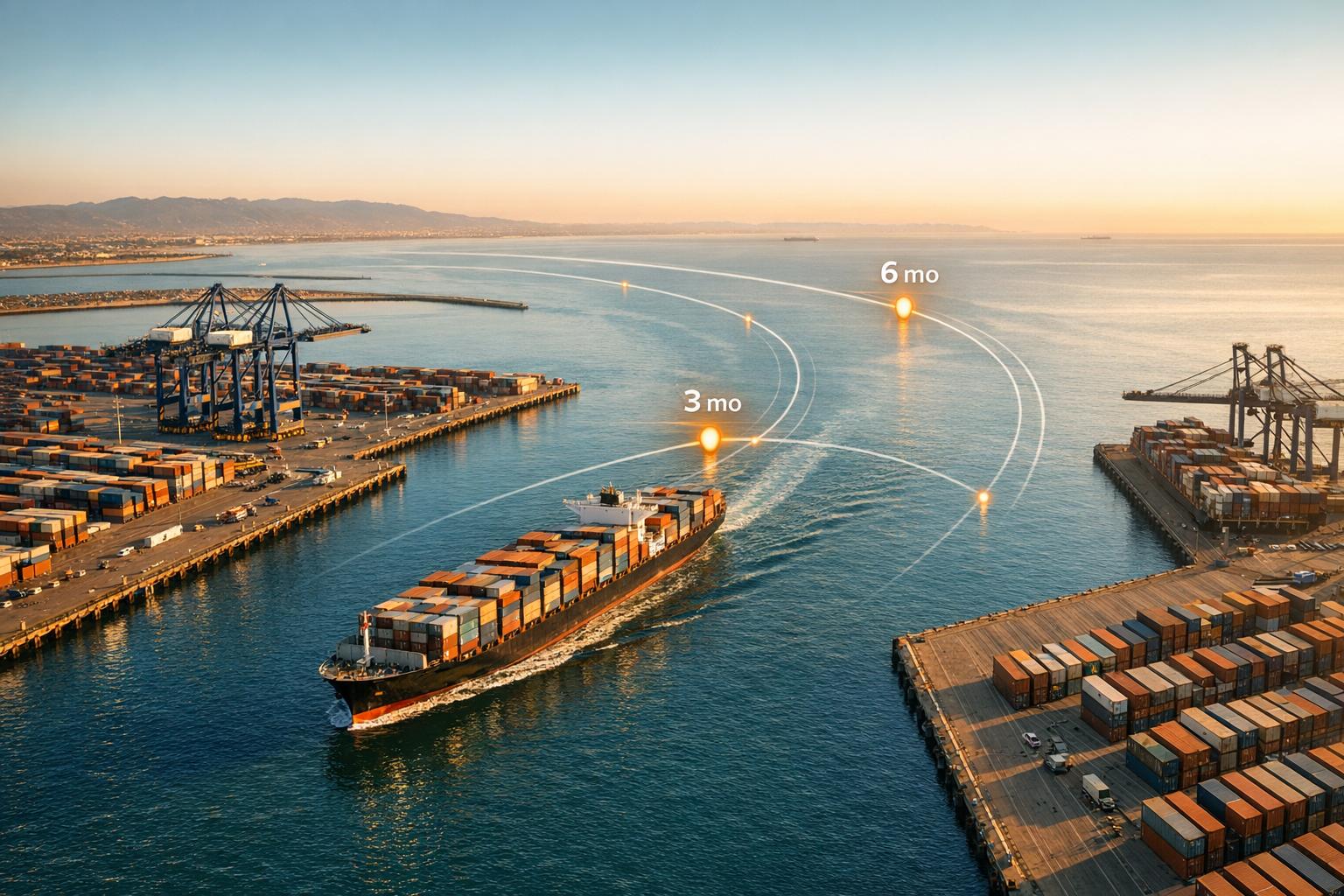
Predictive analytics is transforming global trade risk management in 2026. By analyzing data and forecasting risks months in advance, businesses can reduce disruptions, protect profits, and maintain supply chain stability. Here’s how it’s helping:
- Anticipating Risks: Predictive models forecast issues like supplier defaults, tariff hikes, and shipping delays with 75–85% accuracy.
- Cost Savings: Companies have cut disruption costs by 35% and improved delivery reliability by 15%.
- Real-Life Examples: An electronics manufacturer saved $2.8M by predicting tariff hikes, while an auto parts supplier avoided delays by rerouting shipments during the Red Sea crisis.
- Key Tools: AI, machine learning, and real-time data analysis identify threats early and suggest actionable solutions.
Global Trade Risks Explained
Common Risks in International Trade
In 2026, global trade heavily depends on critical chokepoints and interconnected supply chains. With over 80% of world trade transported by sea, disruptions at key maritime routes like the Red Sea, Strait of Hormuz, and Panama Canal can have immediate and severe financial consequences.
Take February 3, 2026, for instance: Iranian Revolutionary Guards threatened to seize a U.S. tanker in the Strait of Hormuz following the U.S. military’s downing of an Iranian drone near the coast. This incident highlighted how quickly operational risks can escalate. Similarly, climate-driven droughts in 2023 and 2024 led to reduced traffic through the Panama Canal, causing widespread ripple effects across maritime and inland shipping sectors.
"Key sea routes have become areas of tension and vulnerability in several parts of the world." – Credendo
Another growing concern is buyer insolvency and non-payment. In 2025, nearly 800 U.S. companies declared bankruptcy, the highest figure since 2010. Corporate debt levels are straining under rising interest rates and market volatility, increasing the likelihood of customer defaults. Industries like automotive parts, technology, and vehicle financing are feeling the most pressure.
Supply chain disruptions go beyond delayed shipments. For example, China’s control of 80% of rare earth elements creates significant vulnerabilities for electronics manufacturers. Additionally, the EU’s Carbon Border Adjustment Mechanism has introduced compliance delays of 15 to 30 days. These aren’t isolated challenges – they reflect broader systemic risks that can halt operations unexpectedly. On top of these physical and operational risks, economic and political forces are compounding the difficulties faced by global trade.
Economic and Political Risks
Political instability and growing protectionist policies are reshaping the global trade landscape. The war in Ukraine, now in its fifth year as of 2026, remains unresolved, while conflicts in Sudan and the Middle East continue to disrupt established trade routes. Meanwhile, tensions in the South China Sea add uncertainty for businesses operating in Asia-Pacific markets.
These political and economic challenges amplify the operational risks in maritime trade. Trade wars and tariff policies have led to sudden cost increases, forcing businesses to adapt quickly. For example, U.S.-China tariffs in 2025 saw an average hike of 25%, leading to a 20% rise in rerouting costs. Companies like Kimberly-Clark projected an additional $300 million in expenses due to new U.S. tariffs, which significantly impacted their 2025 profit outlook. GE Aerospace faced $500 million in extra costs from trade restrictions alone.
"Global uncertainty leads to lower demand, while businesses are themselves incurring higher costs to become more resilient." – Kerlijne Van Steen, Deputy General Manager and Head of Underwriting, Credendo
Currency instability adds yet another layer of complexity. While the U.S. dollar still underpins over 90% of global transactions as of early 2026, its dominance is under pressure due to high U.S. debt levels and central banks diversifying their reserves. The rising costs of long-term hedging and financial instability linked to stablecoins further complicate matters. In 2025, geopolitical risks alone were estimated to cost global supply chains over $1 trillion. The International Monetary Fund also revised its global growth forecast for 2025 down to 2.8%, citing escalating trade tensions.
sbb-itb-b840488
How Does Predictive Analytics Help Supply Chain Resilience?
How Predictive Analytics Identifies Trade Risks
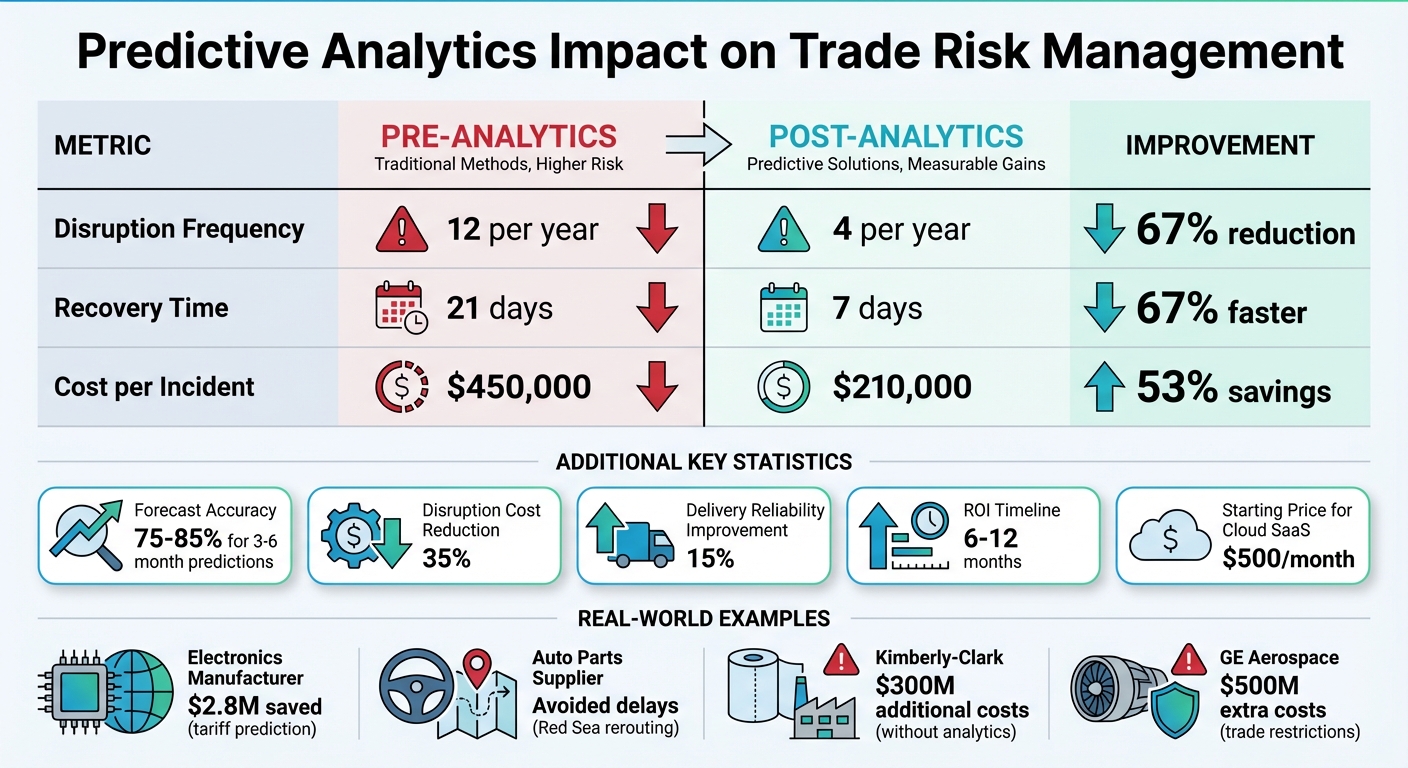
Impact of Predictive Analytics on Trade Risk Management: Before vs After Implementation
What Is Predictive Analytics?
Predictive analytics uses a mix of historical data, machine learning (ML), artificial intelligence (AI), and statistical models to uncover patterns and predict future risks. The process typically includes defining the risk problem, collecting data from various sources, cleaning that data, creating models (like regression or neural networks), and validating the outcomes. By 2025, these advanced systems are expected to deliver 75–85% accuracy for geopolitical forecasts spanning three to six months.
Applications in Trade Risk Management
Predictive analytics takes raw data and turns it into actionable insights for managing trade risks. These systems pull together data from diverse sources, such as news feeds, satellite imagery, trade databases, social media sentiment, and real-time sensor data from GPS and RFID. For example, Natural Language Processing (NLP) scans global news for early signs of political instability, while computer vision tools analyze satellite images of ports to detect congestion or unusual activity.
One notable example is Maersk‘s response to disruptions in the Red Sea during 2024–2025. The company used real-time monitoring to reroute vessels around Africa, adding 10 to 12 days to transit times but enabling adjustments to lead times and order management. Similarly, Apple shifted parts of its manufacturing from China to Vietnam and India during the same period, relying on predictive models to evaluate how tariffs could disrupt supply chains.
These systems also assign risk probabilities (low, medium, or high) and simulate scenarios to test how shocks like tariff increases or trade embargoes might impact operations. De Beers implemented predictive analytics through its "Tracr" blockchain platform between 2024 and 2025. This system tracks diamonds from mine to market, ensuring ethical sourcing and preventing conflict diamonds from entering the supply chain.
Advantages Over Conventional Risk Management
Predictive analytics doesn’t just forecast risks – it also significantly improves outcomes compared to traditional methods. Conventional risk management often reacts to disruptions after they occur, leading to costly delays and emergency measures. In contrast, companies using predictive analytics have cut disruption costs by 35% and improved delivery reliability by 15%.
| Metric | Pre-Analytics | Post-Analytics | Improvement |
|---|---|---|---|
| Disruption Frequency | 12/year | 4/year | 67% |
| Recovery Time | 21 days | 7 days | 67% |
| Cost per Incident | $450,000 | $210,000 | 53% |
Source: FreightAmigo
Traditional methods often struggle with unstructured data like news articles, social media posts, and satellite images. Predictive AI can process vast amounts of this information, identifying threats that manual analysis might overlook. In fact, about 50% of organizations lack a clear understanding of their risk exposure due to the absence of advanced analytical tools.
Cloud-based SaaS platforms have made these predictive tools available to smaller businesses, with pricing starting at $500 per month. Many companies report seeing a return on investment within six to 12 months, thanks to reduced disruption costs and improved operational efficiency.
Steps to Implement Predictive Analytics for Trade Risk Mitigation
Defining Risk Objectives
Start by pinpointing the specific risks your business faces. Conduct an audit to assess supplier exposure to geopolitical challenges and establish Key Risk Indicators (KRIs) based on regulatory standards and past violations. For example, if your company sources electronics from Southeast Asia, your KRIs might focus on tariff changes, port delays, or sudden regulatory shifts in that region. Considering that businesses lose an estimated 5% of annual revenue to fraud and compliance issues, it’s crucial to prioritize areas with the most significant potential impact.
Gathering and Analyzing Data
Once risk objectives are clear, the next step is to consolidate your data for effective analysis. Pull together supplier profiles, certifications, and trade histories into a single platform. Focus on high-value data sources like trade databases, satellite imagery, news feeds, and social signals. A common challenge here is data quality – ensure your data is clean by removing anomalies, addressing missing entries, and eliminating outliers that could distort your models. Approximately 50% of organizations struggle with limited visibility into their risk exposure due to scattered data sources. Creating a unified data repository, such as a data warehouse, provides a connected view of your trade ecosystem.
Building Predictive Models
With clean, centralized data, you can train predictive models to assess risks. Use historical disruption data to develop AI and machine learning models capable of identifying warning signs and assigning risk probabilities – low, medium, or high. Models typically achieve 75–85% accuracy over a three- to six-month period. Building a Minimum Viable Product (MVP) for these models usually takes 4–6 weeks, with full integration completed in about three months. Before automating any processes, test and refine your models by comparing predictions with actual events to ensure reliability.
Integrating Real-Time Monitoring
The final step is connecting predictive tools to your existing systems, such as ERP, Transportation Management Systems (TMS), or Warehouse Management Systems (WMS). This enables real-time risk scoring and anomaly detection, flagging issues like sourcing changes, expired certifications, or inconsistent origin claims. These integrations allow for automated responses, such as rerouting shipments or adjusting inventory, the moment risks are identified. Businesses using this approach have seen a noticeable decrease in disruption frequency and faster recovery times. Cloud-based SaaS platforms make these tools accessible to smaller businesses, with pricing starting at around $500 per month. By turning insights into immediate action, this approach strengthens your ability to proactively manage trade risks on a global scale.
Benefits of Combining Predictive Analytics with Credit Insurance
Improved Financial Protection
Pairing predictive analytics with credit insurance offers a two-pronged defense against trade risks. Predictive models can detect early warning signs – often 6–8 months before a major credit event – giving businesses a chance to adjust credit terms or limits. Meanwhile, credit insurance provides a financial safety net if a buyer defaults. This combination allows companies to address risks actively, reducing the likelihood of unpaid invoices turning into claims. By managing risks in advance, businesses experience fewer losses and position themselves for steady, long-term growth.
Supporting Business Growth
This approach doesn’t just protect – it opens doors for growth. With financial risks mitigated, companies can confidently explore opportunities in emerging markets. Predictive analytics evaluates a company’s likelihood of default over a 12-month period, offering actionable credit recommendations that uncover low-risk prospects often overlooked by traditional methods. Today, over 70% of credit limit applications – representing about 3.4 million requests annually across 140 countries – are processed automatically through AI and machine learning. These systems deliver credit decisions in minutes instead of days. This efficiency allows businesses to act quickly, enabling real-time transactions and removing delays that previously hindered global expansion.
Applications in Global Trade
For industries reliant on international supply chains, this combined strategy is a game-changer. A great example comes from 2020, when Western Digital used a predictive risk engine to shield its supply chain during the COVID-19 pandemic. By anticipating disruptions, the company took preemptive action that saved millions of dollars while keeping operations running smoothly. When paired with credit insurance solutions – like those offered through CreditInsurance.com – businesses gain comprehensive coverage. Predictive tools track buyer health across 180,000 global news sources with 95% accuracy, while insurance safeguards against financial fallout if a buyer defaults. This is especially valuable for manufacturers and retailers managing complex international networks, where visibility into financial health can be limited.
Conclusion
Predictive analytics shifts businesses from reacting to problems after they occur to anticipating and addressing risks before they escalate. By identifying potential issues months in advance, companies can take proactive steps to avoid disruptions. When combined with credit insurance, this approach creates a powerful safety net – helping businesses foresee challenges and recover financially if defaults happen.
The results speak for themselves: businesses leveraging these tools have seen disruption frequency drop by 67%, recovery times shrink from 21 days to just 7, and incident costs cut by 53%. These aren’t minor improvements – they represent a complete overhaul in how companies safeguard their operations and drive growth.
For businesses operating in global markets, sticking to outdated methods based on historical data simply isn’t enough. The fast-changing trade landscape demands real-time monitoring, AI-powered forecasting, and integrated insurance solutions. These tools not only protect businesses but also enable them to expand and streamline their supply chains with confidence.
If you’re ready to strengthen your risk management strategy, CreditInsurance.com offers expert resources to help you combine credit insurance with advanced analytics. The companies that thrive in the future will be the ones that don’t just react to disruptions – they anticipate them, adapt to them, and turn challenges into opportunities.
FAQs
What data do I need to start predictive trade risk analytics?
To start with predictive trade risk analytics, it’s essential to gather high-quality data. This includes credit-related details like a company’s financial health, solvency status, and the likelihood of default within a 12-month timeframe. Beyond that, incorporating external factors – such as geopolitical shifts, supply chain interruptions, and compliance with regulations – adds valuable context.
By blending historical records with forward-looking insights, businesses can better forecast risks such as insolvency or payment failures. This approach equips companies to navigate and manage global trade challenges more effectively.
How do I connect predictive risk scoring to my ERP or TMS?
To bring predictive risk scoring into your ERP or TMS, you’ll need to link predictive analytics tools to your system to process the right data. Start by pinpointing the key data sources you’ll need. Then, use APIs or middleware to establish the connection. Make sure to clean the data to ensure it’s accurate and reliable. Once that’s done, deploy models to calculate risk scores. These scores can then be seamlessly integrated into your ERP or TMS workflows, helping you take proactive steps to mitigate risks and make informed decisions.
How does credit insurance work with predictive analytics?
Credit insurance uses predictive analytics to dive deep into data through advanced models and algorithms. By doing so, it can project a company’s solvency and likelihood of default over the next 12 months. This gives businesses the tools they need to assess risks more precisely and make well-informed decisions.
