
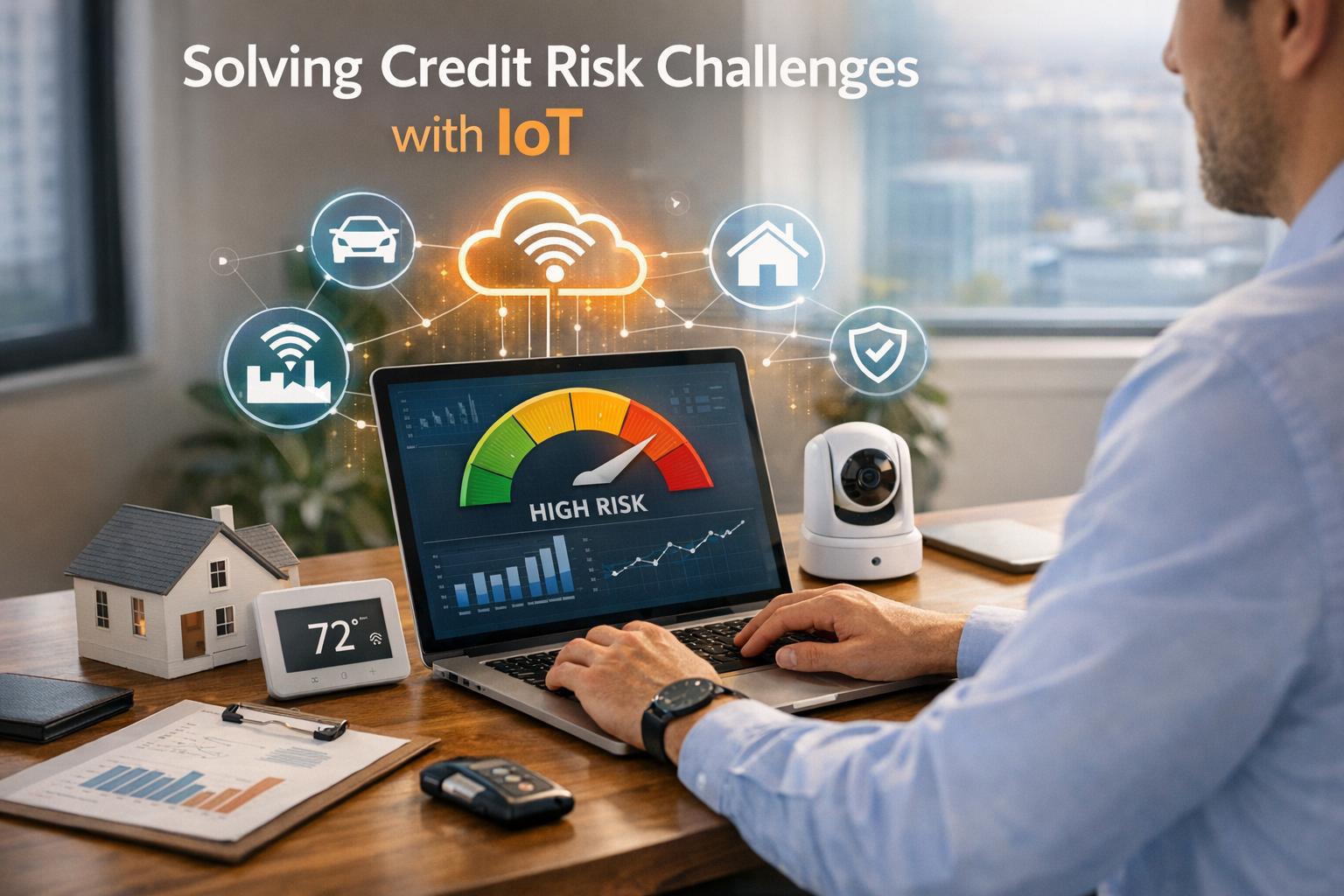
Managing credit risk in B2B transactions is a constant challenge, especially for SMEs. Missed payments, bankruptcies, and supply chain disruptions can severely impact cash flow. Traditional credit assessments, often based on outdated data, fail to address rapid changes in customer financial health. This is where IoT (Internet of Things) steps in.
IoT technology provides real-time data on assets, inventory, and customer behavior, enabling businesses to identify risks early. For example:
- IoT sensors monitor collateral condition (e.g., vehicles, equipment) in real time.
- Automated systems track payment patterns and flag irregularities.
- AI-powered risk models adjust credit decisions dynamically using IoT data.
- Remote enforcement tools (e.g., smart locks) mitigate risks like defaults or fraud.

IoT Credit Risk Management Statistics and Growth Projections
Common Credit Risk Problems Businesses Face
Navigating credit risk in B2B transactions is a complex challenge that can threaten financial stability if not managed effectively. Identifying and addressing these risks requires a proactive approach to monitoring and mitigation.
Late Payments and Customer Bankruptcy
Late payments can wreak havoc on cash flow, forcing businesses to rely on borrowing to cover operational expenses. This creates a ripple effect, amplifying liquidity issues. The situation worsens when large clients default – known as concentration risk – leaving suppliers heavily exposed. Adding to this is the rise of synthetic identity fraud, where fraudsters build credibility before maxing out credit limits, making it harder to distinguish legitimate losses from fraudulent ones. These payment-related challenges highlight a deeper issue: businesses often lack the tools to track changes in their customers’ financial health.
Poor Visibility into Customer Behavior and Creditworthiness
Traditional credit assessments often fall short, relying on static credit scores or outdated claims data that don’t reflect sudden shifts in a customer’s financial situation. As Laura Burrows from Experian explains:
"Credit risk management is the art and science of utilizing risk mitigation tools to minimize losses while maximizing profits from lending activities".
Yet, many businesses struggle to gain real-time insights into their customers’ financial conditions. Evaluating qualitative factors like a customer’s "Character" – their integrity and reliability – adds another layer of difficulty, as these traits are not easily measured by automated systems. Only about 11% of banks have fully automated credit decisions for their SME portfolios, leaving most companies reliant on manual processes and incomplete data. This problem is compounded by data silos, where fragmented information across platforms obscures signs of financial distress or fraudulent activity. Without a clear view of secured assets’ actual condition and utilization, assessing true risk becomes guesswork. This lack of real-time data makes accurate risk evaluation even harder, especially when it comes to collateral valuation.
Outdated Collateral Valuation and Fraud Risks
Collateral valuation often relies on historical data that doesn’t account for real-time changes in asset condition or market value. For instance, failing to integrate climate-related risks into valuations could reduce financial institutions’ profits by as much as 35% by 2030. Fraud detection also suffers from outdated models – conventional credit scoring systems only cover about 81% of U.S. consumers, leaving a significant portion of individuals with limited credit histories unscored. On top of that, vulnerabilities in business systems, such as unencrypted IoT devices, open the door to malware and data breaches. These security gaps not only expose businesses to fraud but also complicate their ability to assess credit risk accurately.
How IoT Technology Solves Credit Risk Problems
IoT technology is reshaping credit risk management by providing real-time data that goes beyond outdated historical credit scores. Instead of relying on information that could be weeks or months old, lenders now have the ability to monitor borrower behavior and collateral conditions as they occur. This shift enables early detection of potential risks, allowing businesses to make proactive adjustments to credit decisions before issues escalate. Let’s dive into how specific IoT applications are making this possible.
As of 2020, there were 30 billion connected devices worldwide, with projections estimating that number will hit 41 billion by 2025. These devices generate a staggering 14 zettabytes of data, much of which comes from equipment and infrastructure used as collateral. Financial institutions are already tapping into this treasure trove of information. For instance, 75% of banks now use machine learning for credit scoring and early warnings, and 37% report cutting SME loan decision times by over 10%.
Real-Time Asset Monitoring with IoT Sensors
IoT sensors give lenders instant updates on the status of collateral. For example, telematics devices track vehicle speed, GPS locations, and driving habits, while industrial sensors measure factors like temperature, pressure, and vibration. These tools can detect changes in assets long before traditional methods like appraisals can.
"The IoT can bring new, potentially very insightful, types of data to the business of calculating risk." – Giambattista Taglioni, Christian Reber, Nathalia Bellizia, and Wallrick Williams, Boston Consulting Group
Here’s how it works in practice: A vehicle’s telematics might flag harsh braking patterns, signaling potential operational issues. Similarly, overheating machinery could indicate wear and tear that impacts its value. Beyond machinery, smart meters tracking energy use can reveal declining business activity, while drones provide real-time site inspections and damage assessments. In agriculture, IoT-enabled tools like smart tractors and soil sensors offer lenders insights into crop quality, helping them gauge a farmer’s ability to repay loans.
Automated Payment and Behavior Tracking
IoT technology doesn’t just stop at monitoring assets – it also tracks payment behaviors and usage patterns. Devices can automatically flag irregular payment activity, while tools like smart locks and biometric scanners ensure that only authorized individuals access credit-funded assets. These systems create a detailed audit trail of usage.
If payment issues arise, IoT actuators can step in to remotely disable assets, such as locking a vehicle or shutting down a smart appliance. Blockchain technology further enhances this process by recording payments in an immutable ledger and enabling assets to operate only after verifying real-time payments. Models like "Pay-as-you-drive" (PAYD) and "Pay-how-you-drive" (PHYD) are excellent examples of how credit terms are evolving to reflect real-world usage rather than demographic averages.
Dynamic Risk Assessment Using IoT Data
IoT data, combined with AI, is making risk assessment more dynamic than ever. Instead of relying on static, historical data, lenders can now use real-time insights to refine credit decisions continuously. For example, machine learning models built on IoT data have achieved credit risk prediction accuracy rates exceeding 80%. This allows lenders to adjust interest rates or credit limits based on current borrower behavior, moving away from one-size-fits-all assessments.
"This shift from static historical data to dynamic high-frequency information allows financial institutions to continuously monitor and swiftly respond to emerging risks." – Kenneth Chen, Managing Director, Quantitative Advisory Services, Ernst & Young LLP US
Generative AI is also stepping into the mix, streamlining loan applications and improving risk model validation for compliance. In commercial insurance, where traditional damage assessments can take months and cost up to 10% of premiums, IoT-powered tools like drones and computer vision are automating data collection. This hybrid approach – where machines handle repetitive tasks while humans focus on complex decision-making – is paving the way for smarter, faster credit risk management.
IoT Solutions for Collateral Management and Fraud Prevention
IoT technology is transforming how lenders handle collateral management and fraud prevention. The global market for IoT-based asset tracking and monitoring is expected to grow from $3.77 billion in 2021 to $9.46 billion by 2030. Traditionally, verifying collateral meant sending inspectors to physically check assets – a process that could cost 6% to 10% of premiums and take weeks. Now, continuous sensor data offers a faster, more cost-effective alternative, enabling remote verification and proactive risk management.
Remote Verification and Tamper Detection
IoT sensors provide real-time updates on the location and condition of collateral, eliminating the need for expensive and time-consuming site visits. For example, GPS trackers combined with geo-fencing technology can instantly alert credit managers if high-value assets like construction equipment or vehicles leave approved areas. Additionally, sensors can detect tampering by monitoring changes in light, vibrations, or shocks that suggest interference.
Lenders can also track critical metrics like engine hours, mileage, fuel usage, and speed. This data can reveal patterns that breach contract terms or indicate unauthorized use. A user of Cisco‘s IoT Control Center shared their experience:
"We can see if a device is connecting or not in just a couple mouse clicks, and we can manage issues ourselves at any time – day or night".
Environmental sensors provide further protection by monitoring factors like temperature, humidity, and water exposure. This ensures assets are maintained according to agreements and helps prevent fraudulent claims of property damage.
Automated Enforcement and Risk Mitigation
IoT doesn’t stop at monitoring – it enables immediate action when risks are detected. For instance, if fraud or payment default is identified, IoT actuators can remotely disable vehicles, equipment, or properties using locks, alarms, or kill switches. In sectors like microfinance and agriculture, lenders can remotely lock solar panels or tractors based on repayment status.
Advanced connectivity platforms also detect unusual device activity, such as SIM theft or unauthorized data usage. Multi-layered security measures protect these systems from hackers attempting to disrupt monitoring. Machine learning further enhances fraud detection by analyzing device behavior. One financial institution reported identifying an additional $1.5 million in previously undetected fraud each month while reducing false positives by nearly $1 million.
sbb-itb-b840488
Using IoT for Credit Risk Management with CreditInsurance.com

Combining IoT monitoring with credit insurance can help businesses stay ahead of risks like payment defaults and insolvency. With global business insolvencies expected to rise by 2.8% in 2026, companies need tools that provide real-time insights and financial protection. This approach shifts the focus from simply reacting to claims to proactively preventing risks. CreditInsurance.com enables businesses to integrate IoT data with credit insurance strategies, offering immediate financial safeguards alongside IoT-driven risk monitoring.
Educational Resources on IoT and Credit Insurance
CreditInsurance.com provides resources to help businesses understand how IoT technologies, like sensors and Digital Twins, can work with trade credit insurance. Their guides include a six-phase implementation process for using Digital Twins in supply chains, showing how real-time asset monitoring can lead to measurable returns and better risk management. Additionally, the platform’s Credit Insurance Terms Glossary explains complex terms like "protracted default" and "political risk", making it easier for businesses to navigate dynamic risk scenarios.
One of the platform’s key insights is that credit insurance can cover up to 95% of unpaid invoices caused by buyer defaults or insolvencies. By integrating IoT-enabled behavioral analytics and real-time transaction monitoring, companies can adjust their coverage and credit limits based on current customer behavior instead of relying solely on outdated credit scores.
Customized Insurance Plans for Better Risk Protection
CreditInsurance.com also connects businesses with specialists who design insurance plans tailored to their IoT-based monitoring systems. For example, companies can choose between annual sales-based pricing – typically $0.10 to $0.20 per $100 of domestic insured sales – or coverage-based pricing. The platform ensures businesses find the best pricing model to complement their real-time IoT tracking, all without extra fees for working with a broker. Rates remain the same whether purchased through a specialist or directly from an insurance carrier.
These customized plans protect cash flow when IoT systems detect risks like unauthorized asset movement or declining equipment performance. Additionally, credit insurance can improve borrowing potential, allowing advance rates of up to 90% on domestic and export sales. This ensures businesses maintain financial flexibility to grow while IoT systems continuously monitor collateral health and customer payment trends. By integrating real-time monitoring with strategic financial protection, businesses can make smarter credit decisions and safeguard liquidity even in uncertain times.
Conclusion: Using IoT to Solve Credit Risk Problems
IoT is reshaping credit risk management by moving beyond outdated tools like static credit scores and annual financial statements. Instead, it enables continuous monitoring of collateral locations, equipment performance, and customer behavior. This approach helps detect early warning signs as much as six to eight months in advance, providing a proactive edge to risk management.
With projections estimating 41 billion connected devices globally by 2025, this vast IoT network offers reliable, real-time data that can significantly reduce fraud-related losses. Additionally, remote enforcement features – like disabling equipment when a default occurs – offer immediate and effective risk mitigation, something traditional methods simply can’t achieve.
"Transitioning from traditional methods to dynamic real-time data and advanced analytics allows banks to proactively address emerging risks and enhance their overall risk management strategies."
- Kenneth Chen, Managing Director, Ernst & Young LLP US
FAQs
How does IoT help improve credit risk assessments?
The Internet of Things (IoT) brings a new level of precision to credit risk assessments by providing real-time data on how borrowers are operating and managing their finances. Instead of depending solely on outdated or historical records, businesses can now base their evaluations on up-to-the-minute insights.
With IoT, companies can track essential factors like inventory levels, payment patterns, and operational efficiency. This continuous monitoring helps spot potential risks earlier, allowing for smarter, more informed credit decisions. Ultimately, this approach minimizes guesswork and enhances the reliability of risk assessments.
How do IoT sensors help monitor the condition of collateral?
IoT sensors play a key role in tracking the status of collateral by delivering real-time insights into factors like equipment performance, supply chain movements, and surrounding conditions. With this data, businesses can get a clearer and more precise understanding of their collateral’s current value and condition.
By offering constant monitoring, IoT technology helps spot potential issues early – whether it’s a piece of equipment showing signs of failure or external threats like adverse conditions. This allows businesses to act swiftly, safeguard their assets, and reduce credit-related risks.
How can businesses use IoT data to improve their credit insurance strategies?
Leveraging IoT data can provide businesses with real-time insights into customer activities, asset conditions, and operational performance. This kind of data goes beyond traditional financial metrics, offering a more dynamic picture of borrower behavior. For instance, factors like supply chain efficiency or how frequently equipment is used can add depth to borrower profiles.
By tapping into IoT data, businesses can spot early warning signs of potential risks – think payment delays or operational hiccups – before they escalate. This enables proactive steps, such as adjusting credit limits or premiums, to minimize exposure to issues like non-payment or insolvency. On top of that, IoT-powered predictive models can enhance risk assessment, paving the way for more customized coverage options. This approach not only mitigates risk but also builds trust and fuels business growth.
